Setting the Stage: ASCO 2026 and the Rise of Chinese ADC Innovation
The 2026 American Society of Clinical Oncology (ASCO) Annual Meeting was held from May 29 to June 2 in Chicago. At this year's congress, advances in precision treatment for gastrointestinal (GI) cancers drew particular attention. Among them, antibody-drug conjugates (ADCs), with their unique mechanisms of action and outstanding clinical efficacy, emerged as one of the most closely watched research directions. Multiple pivotal clinical datasets from Chinese original ADCs were unveiled, sparking extensive discussion among global peers.
During the meeting, we had the privilege of interviewing Professor Li Jin, President of China Pharmaceutical University Affiliated Shanghai GOBROAD Cancer Hospital, to discuss core breakthroughs in GI oncology at this year's ASCO, the clinical value of Chinese original ADCs, and the path forward for international development of China's innovative oncology drugs.
Part 1: Key Research Frontiers in GI Oncology at ASCO 2026
ctDNA in Prognostic Prediction
Oncology Frontier: Professor Li, the annual ASCO gathering is here again. Focusing on GI cancers, could you share which landmark studies caught your attention at this year's meeting?
Prof. Li Jin: Research priorities in GI oncology at this year's ASCO focused on several key areas.
First, the application value of circulating tumor DNA (ctDNA) in tumor prognosis prediction. The clinical value of ctDNA in adjuvant therapy remains academically contested, with differing results across studies. Further exploration is needed to develop application protocols suited to Chinese populations. Improving ctDNA detection accuracy and prognostic prediction efficacy will provide critical evidence for adjuvant treatment decisions — especially significant for Stage III patients. Through precise ctDNA-based screening to identify populations with extremely low recurrence risk who may not need chemotherapy, individualized treatment de-escalation can be achieved while avoiding overtreatment. This is a direction of substantial clinical value.
BRAF and RAS Mutation Inhibitors
Second, clinical research on BRAF mutation inhibitors continues to expand. From BEACON to BREAKWATER and subsequent studies, therapeutic options for this challenging target have been continuously enriched.
Third, the future clinical application of RAS mutation inhibitors remains a priority focus in precision treatment for GI cancers.
HER2-Targeted Therapy: A Standout Highlight
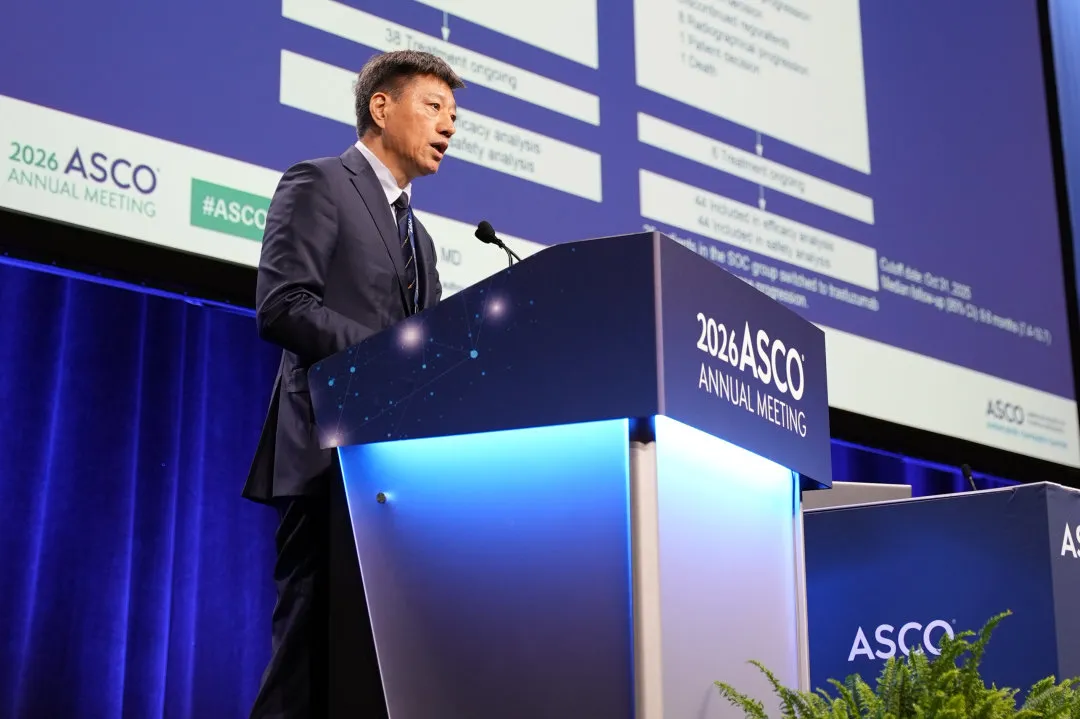
Beyond these areas, HER2-targeted therapy emerged as a standout highlight of this year's congress. HER2 is an important target in colorectal cancer, alongside BRAF, RAS, and PI3K, and has garnered intense global academic attention this year. At this meeting, I presented the HORIZON-CRC01 Phase 3 clinical study, led by our team, evaluating trastuzumab rezetecan (SHR-A1811) for chemotherapy-refractory, HER2-positive, RAS and RAF wild-type advanced colorectal cancer.
HORIZON-CRC01 Phase 3 Key Results:
- Median PFS: 5.5 months (trastuzumab rezetecan arm) vs. 2.8 months (control arm)
- Hazard Ratio: Pre-specified HR of 0.4; actual HR of 0.33 — exceeding expectations
- Phase 1 median PFS: 9.5 months (difference largely attributable to baseline patient status and multicenter enrollment criteria variations)
- Safety: Overall controllable. Grade 3 or higher treatment-related adverse events (TRAEs): 48.8% vs. 50.0% in control. Most common Grade 3+ events: neutropenia, anemia, thrombocytopenia
- No patient discontinued treatment due to TRAEs. Interstitial lung disease (ILD) incidence only 1–2%, mild severity, no life-threatening cases
Part 2: CLDN18.2-Targeted ADC — The Future of Gastric Cancer Precision Therapy
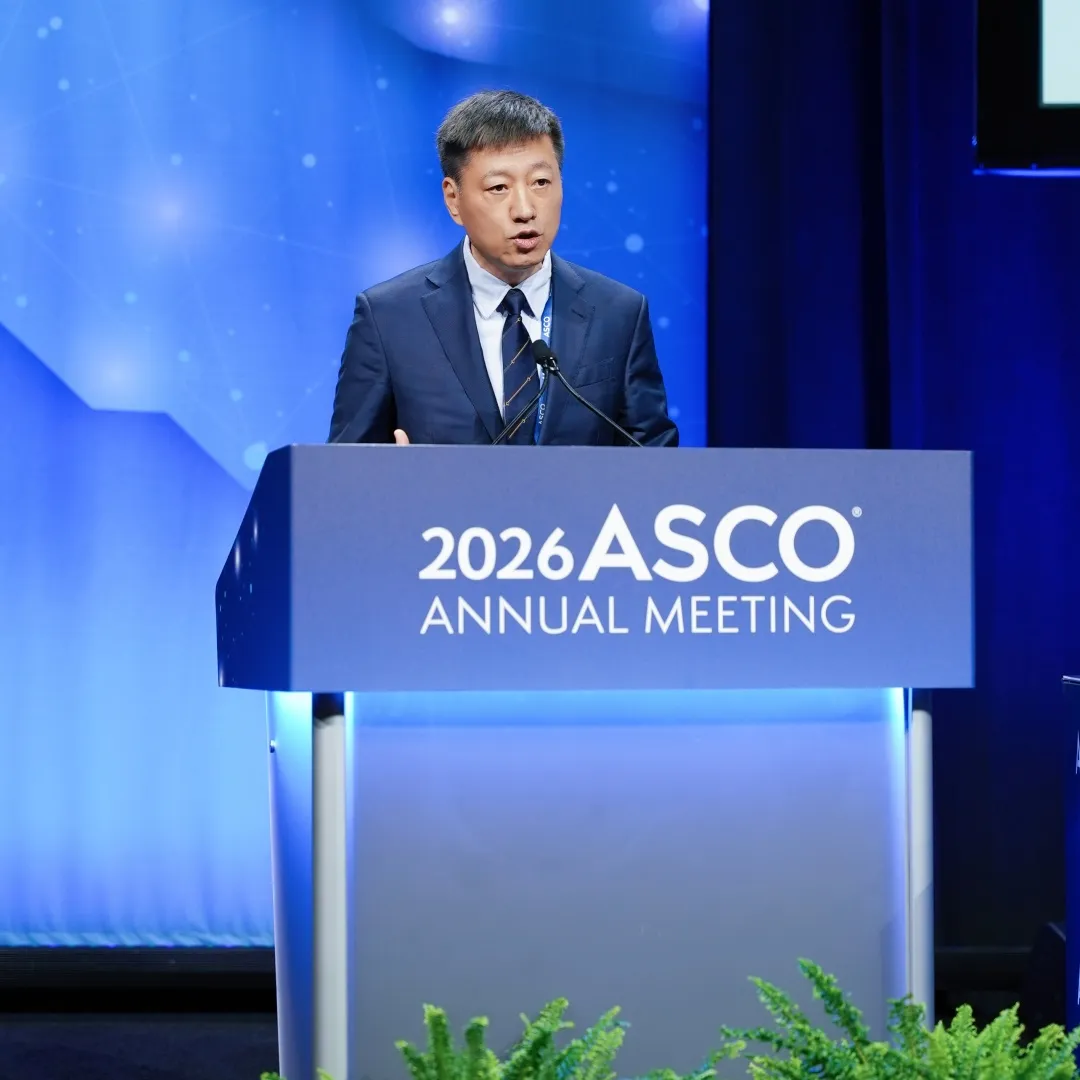
Oncology Frontier: In the era of precision medicine, ADC research and development in China's GI oncology field is flourishing. You also shared clinical data on the CLDN18.2-targeted ADC tecotabart vedotin (LM-302) for advanced gastric or gastroesophageal junction cancer. Could you discuss the prospects of CLDN18.2-targeted therapy in gastric cancer based on this study?
Prof. Li Jin: At this year's congress, our team also presented a poster on tecotabart vedotin (LM-302). As of early 2026, four CLDN18.2 ADC projects worldwide have entered Phase 3 clinical trials. Our team has completed the Phase 3 clinical study of LM-302 in third-line treatment. The data presented at this meeting are from the Phase I/II clinical trial of LM-302 in first-line treatment.
LM-302 First-Line Phase I/II Results:
- Regimen: LM-302 combined with toripalimab with or without chemotherapy
- Doublet cohort median PFS: 10.68 months
- Triplet cohort median PFS: 12.55 months
- CLDN18.2 high-expression subgroup ORR: 64.5% (doublet) vs. 69.2% (triplet)
- Efficacy showed improvement over standard chemotherapy or standard chemotherapy combined with PD-1 monoclonal antibody, with lower toxicity and controllable safety profile
Based on these Phase I/II results, we have initiated a head-to-head Phase 3 clinical trial comparing standard chemotherapy against LM-302 combined with PD-1 monoclonal antibody in terms of efficacy and safety. We look forward to positive results from this pivotal study.
Part 3: China's Path to Global Leadership in Oncology Innovation
Oncology Frontier: As Chinese original drugs and innovative research continue to take the international stage, China's innovative treatment concepts and strategies have become an important force driving global GI cancer development. How do you think China should further strengthen its international academic standing and lead the forefront of cancer treatment?
Prof. Li Jin: At this year's ASCO, 94 Chinese studies were selected for oral presentations. From 2014, when I first represented mainland China at ASCO to report on apatinib — when only one domestic study was selected — to nearly 100 studies showcased today, this tremendous leap fully demonstrates that Chinese clinical research has gained broad recognition from international peers and is steadily advancing to the world's frontier.
China's biomedical industry shows strong momentum. According to statistics, in 2025, China's biomedical sector out-licensing (BD) transaction volume reached USD 130 billion, accounting for half of the global total — highlighting the global influence of Chinese innovative drugs. Although no Chinese pharmaceutical company has yet entered the top 20 in global pharmaceutical sales, this is primarily because domestic companies are relatively small in scale, and domestic drug pricing is only a few dozenths of that in European and American markets. With accelerated international expansion, world-class large pharmaceutical enterprises will inevitably emerge in China within the next 3–5 years, and Chinese pharmaceutical companies entering the global top 10 in sales can be expected within 10 years.
China's Three Core Advantages in Biopharma Development:
- Largest patient population globally: Provides a solid foundation for clinical research
- High-caliber clinical research teams: Approximately 50 Principal Investigators (PIs) in China have reached world-class levels
- Vibrant industry ecosystem: 14,000–15,000 biomedical companies with rich product pipelines forming full competitive dynamics
Facing intense domestic competition, we should not limit ourselves to "spring roll-style" competition within the domestic market. Instead, we should pivot toward "flower roll-style" development — extending competition into European, American, and other global markets through technological innovation and clinical research breakthroughs, competing at a world-class level. Although some countries attempt to restrict entry of Chinese biopharmaceutical products into their markets, the trends of capital flow and technological innovation cannot be blocked in the long term. The rise of China's biomedical industry is unstoppable, and it will inevitably become an important leader in global cancer treatment innovation.
About the Featured Expert
Prof. Li Jin (李进)
President, Shanghai GOBROAD Cancer Hospital (China Pharmaceutical University Affiliated)
Lifetime Professor, Tongji University Affiliated Shanghai East Hospital
Clinic Schedule: Every Monday All Day, Thursday Morning, Saturday Morning
Chief Physician / Professor / Doctoral Supervisor
Specialization: Focuses on digestive system malignancies, with expertise in molecular targeted therapy, immunotherapy, investigational new drug clinical trials, and multidisciplinary team discussions for complex solid tumors, particularly gastrointestinal cancers.
Academic appointments: President, Asian Federation of Medical Oncology (FACO); Chairman, CSCO Colorectal Cancer Expert Committee; Director-General, National Health Commission Center for Capacity Building and Continuing Education; Chairman, Beijing CSCO Clinical Oncology Research Foundation; Vice-Chairman, Chinese Medical Continuing Education Association Abdominal Oncology Committee; Chairman, Shanghai Waigaoqiao Cell and Gene Therapy Industry Alliance; Deputy Editor-in-Chief, Cancer Science.
Learn More or Contact Us
If you are interested in learning more details about these clinical trials or other advanced treatment options at GOBROAD hospitals, please contact us. We strictly protect your personal information in accordance with applicable regulations.