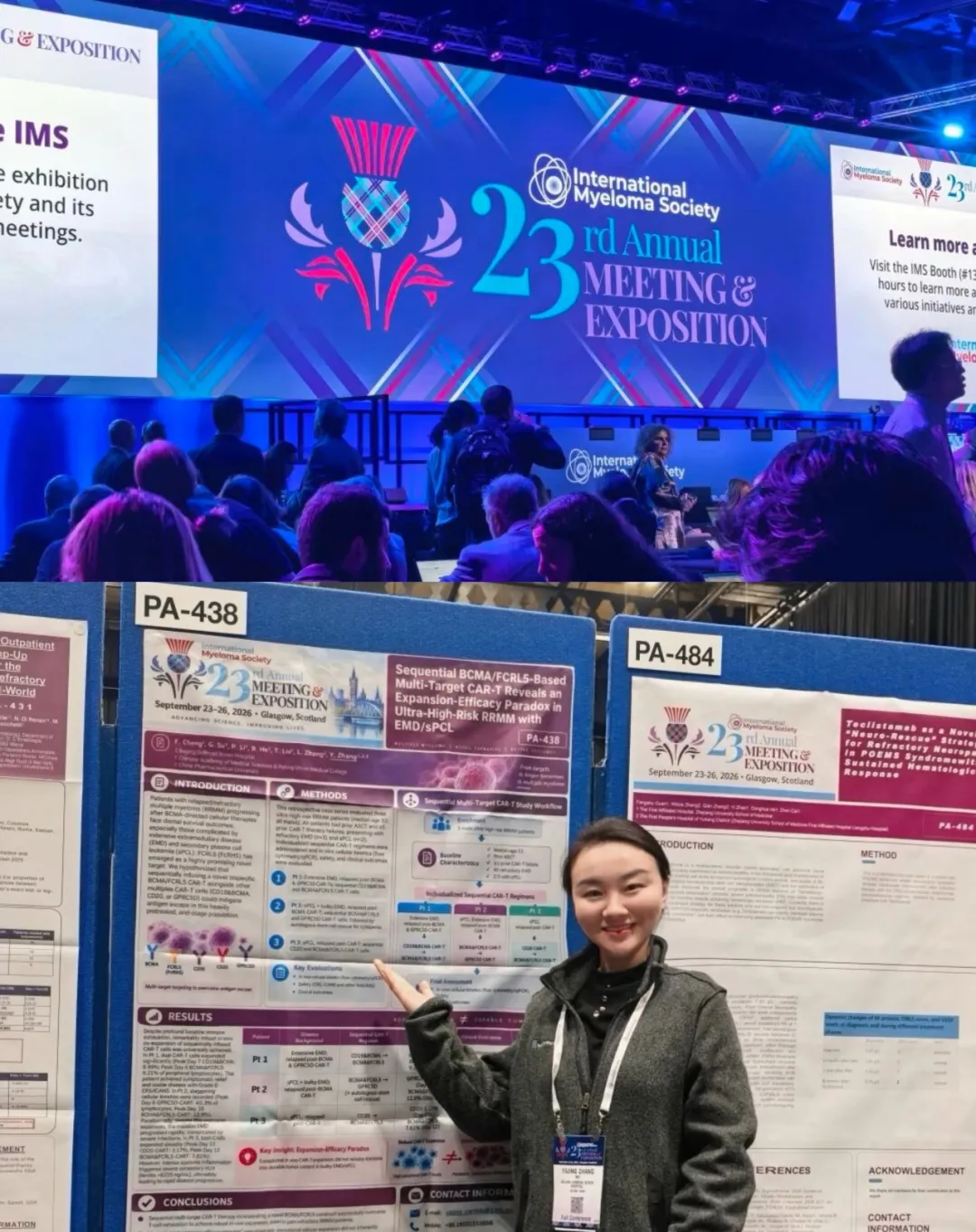
The International Myeloma Society (IMS) brings together basic scientists, clinical investigators, and hematologists from across the world who work on multiple myeloma and plasma cell disorders, advancing the full chain from disease mechanism through translational research to clinical care. The IMS Annual Meeting is one of the field's most important yearly forums.
The 23rd IMS Annual Meeting was held September 23–26, 2026 in Glasgow, UK. Four studies led by Prof. Zhang Yajing's team at Beijing GOBROAD Boren Hospital, GOBROAD Medical Group, were accepted as posters. All four focus on relapsed/refractory multiple myeloma (RRMM), with particular emphasis on extramedullary disease (EMD) and secondary plasma cell leukemia (sPCL) — populations where clinical management remains especially difficult.
These studies circle a single question:
When the tumor keeps evolving under continuous treatment pressure, how should clinicians decide which target to choose next? When is the right time to switch strategy? And when CAR-T cells have already achieved good expansion, why might the disease still not be effectively controlled?
Prof. Zhang Yajing's team has not stopped at the static question of "is a given target positive or negative?" Instead, the work starts from the current lesion and continuously tracks antigen expression, genomic change, and the immune microenvironment — turning that dynamic information into target selection, exclusion, and timing decisions for sequential cellular therapy.
Four Posters, One Coherent Research Chain
Abstract PA-498 — Tissue-Defined Antigen-Immune States Reveal Actionable Evolution in Extramedullary Myeloma
Extramedullary multiple myeloma (EMD-MM) often develops complex antigen shifts after BCMA- or GPRC5D-directed therapy; prior bone-marrow testing may no longer reflect the current lesion state. The team performed serial lesion analyses on 8 R/R MM patients with EMD and found that targets do not simply disappear — they may vanish, weaken, re-rise, or be replaced by unconventional targets.
GPRC5D showed copy-number loss or marked expression decline, but in some patients also rebounded from 0% to 50% after BCMA CAR-T failure. BCMA expression ranged from complete loss to 80%–90% high across different lesions; focal CD19 and 70%–80% CD70 expression also appeared. Several lesions showed T-cell infiltration deficits — an immune-exclusion signature. The work argues that subsequent treatment cannot rely solely on prior targets but must integrate the antigen and immune state of the current lesion in real time.
Abstract PA-439 — Serial EMD Antigen Mapping Guides Sequential CAR-T Targeting in Relapsed/Refractory Multiple Myeloma
Target choice for sequential CAR-T often relies on prior bone-marrow data, but for aggressive extramedullary relapse those signals may already be obsolete. The team performed 2–4 serial lesion biopsies in 8 EMD patients and tracked target shifts before and after treatment.
Antigen evolution was clearly bi-directional and lesion-specific: GPRC5D dropped from 40% to 5% and from 50% to undetectable in some lesions, but in others rebounded from 0% to 50% after BCMA CAR-T failure; BCMA was completely lost in some lesions while remaining at 80%–90% in others, and alternative targets such as CD19 and CD70 emerged.
The work supports re-assessing the current lesion before every treatment switch — and from there, prioritizing, excluding, or substituting targets so that sequential CAR-T moves from a pre-set "target order" toward real-time, lesion-informed dynamic adjustment.
Abstract PA-278 — Lesion-Based Antigen Remapping Reveals Dynamic Target States for Sequential CAR-T Therapy in Relapsed/Refractory Multiple Myeloma
This study formalizes the concept of "lesion-based antigen remapping": targets are not simply positive or negative but are highly dynamic and spatially heterogeneous across lesions and over time.
BCMA dropped from 65%–90% expression to 10% or even complete loss; GPRC5D ranged from negative to strongly positive; in some plasmablastic lesions with BCMA loss and very low GPRC5D, regional CD19 expression reached around 70%. Several lesions also showed marked immune-cell paucity.
This argues that target evolution after immunotherapy is not a simple linear swap between antigens. For aggressive extramedullary relapse or plasmablastic relapse, precise sequential CAR-T decisions must shift from "treating by the prior target order" to re-identifying treatable targets based on the current lesion.
Abstract PA-438 — Sequential BCMA/FCRL5-Based Multi-Target CAR-T Reveals an Expansion-Efficacy Paradox in Ultra-High-Risk RRMM with EMD/sPCL
Whereas the first three studies answer "what target comes next?", this study pushes the question further: even when CAR-T cells expand well in vivo, why might the disease still escape control?
Three ultra-high-risk RRMM patients with refractory EMD (two of them also with sPCL) were treated with sequential multi-target CAR-T incorporating BCMA/FCRL5. All three patients showed significant CAR-T expansion, but clinical outcomes diverged: some achieved stable disease, while others — even with high CAR-T expansion ratios — developed bulky EMD progression, severe infection, or secondary hemophagocytic lymphohistiocytosis (HLH).
From these observations, the team proposes the concept of an "expansion–efficacy paradox": CAR-T expansion in vivo does not equal sustained tumor control. Physical lesion barriers, tumor burden, rapid disease progression, and excessive inflammatory response can all determine final efficacy.
The implication is that optimizing multi-target CAR-T is not only about which targets to choose but also about when to intervene and whether the patient is still in a disease state that can benefit. The authors flag the possibility of moving multi-target CAR-T earlier in the treatment course as a direction worth further exploration.
From "Target Selection" to "Disease-State Judgment"
The four studies together form a progressively deepening chain:
From recognizing that antigen and immune states of extramedullary lesions keep evolving, to identifying target disappearance, re-emergence, and replacement through continuous lesion monitoring; to remapping antigens lesion-by-lesion and re-judging what is truly treatable now; and finally to showing that even when targets are clear and CAR-T cells expand successfully, lesion microenvironment, tumor burden, and inflammatory state can still become the limiting factors.
Sequential CAR-T's clinical question therefore evolves from the original:
"What target do we use next?"
into a sharper one:
"What is the biological state of the disease right now — and how should that shape our next treatment choice?"
Let treatment follow the disease.
Extramedullary myeloma is not a static disease defined by a single target. Under sustained therapeutic pressure, the same patient may present entirely different antigen combinations across lesions and time; meanwhile, each lesion's immune microenvironment further determines whether CAR-T cells can actually enter and act inside it.
Sequential CAR-T, therefore, should not be a pre-arranged "target menu." Confirming targets that remain, excluding those that have lost accessibility, re-evaluating prior targets, searching for new candidate targets, and judging the patient's current disease burden and immune state can all become part of precise cellular-therapy decision-making. Prof. Zhang Yajing's research underscores that treatment strategy needs to be recalibrated as the disease evolves.
From Research Findings Toward Clinical Practice
Currently, these four studies are primarily small-sample cohorts, descriptive analyses, and case series. Their value lies in revealing clinical phenomena, proposing new treatment-decision frameworks, and identifying scientific questions for further validation; they cannot yet replace prospective efficacy comparisons.
Future sequential cellular-therapy research will need to integrate lesion antigen state, MRD / circulating tumor DNA, CAR-T cell kinetics, immune microenvironment, treatment toxicity, and survival endpoints into a more complete evaluation system, and to explore whether multi-target therapy should be initiated earlier — before patients reach extreme tumor burden and severe immune imbalance.
The value of Prof. Zhang Yajing's four IMS 2026 posters is to advance the clinical question "what target should we use next?" into a recognition and judgment of the current dynamic state of the disease. From one-time testing to continuous monitoring, from single targets to whole-lesion profiling, from empirical sequencing to real-time evidence-driven individualized decisions — this is the direction worth pursuing for precise cellular therapy in complex RRMM.
About the Expert
Zhang Yajing
Beijing GOBROAD Boren Hospital, GOBROAD Medical Group
Director, Oncology & Immunology · Innovative Medical Center, Beijing Boren Hospital
Chief Physician / M.D. / Postdoctoral Fellow / Master's Supervisor, China Pharmaceutical University / Beijing Science and Technology Nova
Clinical and Research Focus: Long-term focus on the clinical application and translational research of cellular and immune therapy in oncology and autoimmune diseases, combining solid clinical experience with deep academic work.
Research Leadership: Principal investigator on 8 international cooperation projects, National Natural Science Foundation of China grants, and provincial/ministerial programs. First or co-first author publications in Blood, Leukemia, JEM, STTT, and other high-impact journals, with cumulative IF above 150.
Academic Recognition: Recipient of the JEM 2023 Best Paper Award, the Nanyue Science and Technology Outstanding Paper First Prize, and the PLA General Hospital Science and Technology Progress Second Prize.
Academic Appointments: Researcher at the Institute of Hematology, Chinese Academy of Medical Sciences; standing committee or committee member in more than ten national academic organizations, including the Chinese Research Hospital Association (Cell and Biotherapy Committee), CSCO (Multiple Myeloma Expert Committee), and the Chinese Cancer Foundation (Hematologic Oncology Rehabilitation Core Expert Group).
Standards and Consensus: As a primary drafter and writer of standards and consensus in the CAR-T field, has contributed to the following documents:
- Shanghai Pharmaceutical Industry Association group standard: Guidelines for Long-Term Follow-Up Clinical Studies of Chimeric Antigen Receptor T Cell (CAR-T) Therapeutic Products
- Clinical Management Pathway Guidelines for CAR-T Cell Therapy NHL Toxicity and Side Effects
- Expert Consensus on Clinical Management of CAR-T Cell Therapy NHL Toxicity and Side Effects
For outpatient information and the latest schedule, please contact MedTourChina before planning your visit.
This article is a press summary based on conference abstracts and is intended for general informational purposes only. It does not constitute medical advice, diagnosis, or treatment. Please consult a qualified physician for any medical decision.