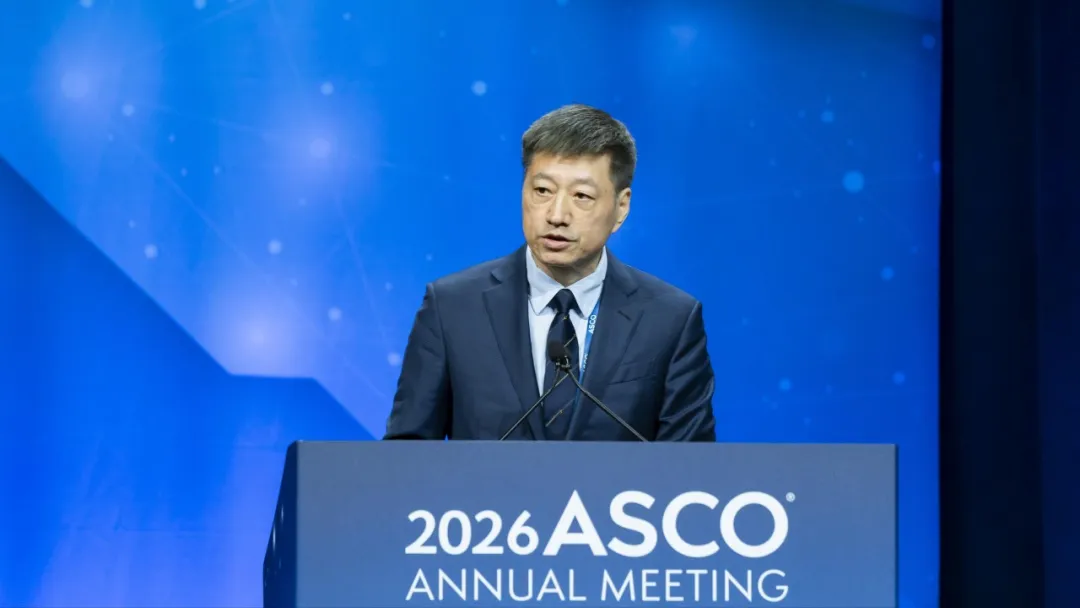
A Landmark Presentation at ASCO 2026
The 2026 American Society of Clinical Oncology (ASCO) Annual Meeting was held from May 29 to June 2 in Chicago. As one of the most influential global gatherings in oncology, ASCO serves as a premier platform for releasing frontier research findings and updating cancer treatment paradigms.
At this year's congress, the world's first Phase 3 randomized controlled trial for HER2-positive metastatic colorectal cancer (mCRC), known as HORIZON-CRC01 (NCT06199973), was officially presented as an oral report by its Leading PI, Professor Li Jin, President of Shanghai GOBROAD Cancer Hospital (affiliated with China Pharmaceutical University). The study provides higher-level evidence-based medicine for HER2-positive mCRC and is expected to reshape the treatment landscape.
HER2: A Key Target in the Era of Precision Medicine for mCRC
HER2 is a well-established oncogenic driver gene whose abnormal activation is closely linked to tumor cell proliferation, invasion, and metastasis. While long recognized as a classic precision target in breast and gastric cancers, the clinical value of HER2 in colorectal cancer has been increasingly re-evaluated in recent years.
Prof. Li Jin notes that although the overall positivity rate of HER2 in colorectal cancer is only about 3% to 5%, this proportion rises to 5% to 14% in RAS/BRAF wild-type populations. More importantly, HER2 amplification is also a key mechanism of resistance to anti-EGFR therapy. These factors make HER2 a target with significant clinical value and therapeutic potential in mCRC.
As mCRC enters the era of molecular subtyping, the importance of HER2 testing continues to grow. HER2 testing not only helps identify patients who may benefit from HER2-directed therapy but also enables better patient stratification and optimization of subsequent treatment strategies, driving the precision oncology system toward greater standardization and individualization.
However, challenges remain. The criteria for defining HER2 positivity in mCRC still lack a widely validated companion diagnostic standard, and HER2 testing has not yet been fully integrated into routine clinical workflows alongside RAS, BRAF, or MSI testing. Meanwhile, treatment options for patients with HER2-positive mCRC after standard therapy failure remain limited. Traditional later-line regimens such as TAS-102, fruquintinib, or regorafenib yield a median progression-free survival (PFS) of only 1.9 to 3.7 months and an objective response rate (ORR) no higher than 5%. Improving screening rates, standardizing testing protocols, and providing more effective targeted therapies are urgent unmet clinical needs.
HORIZON-CRC01: Global First Phase 3 Trial
HORIZON-CRC01 is a randomized, open-label, active-controlled, multicenter Phase 3 clinical trial co-led by Prof. Li Jin and Prof. Yuan Ying from the Second Affiliated Hospital of Zhejiang University School of Medicine. It builds on the success of the earlier SHR-A1811-I-102 Phase 1 study, whose results were published in the Journal of Clinical Oncology (IF = 43.4), demonstrating encouraging anti-tumor activity and a favorable safety profile for trastuzumab rezetecan in HER2-positive gastrointestinal malignancies.
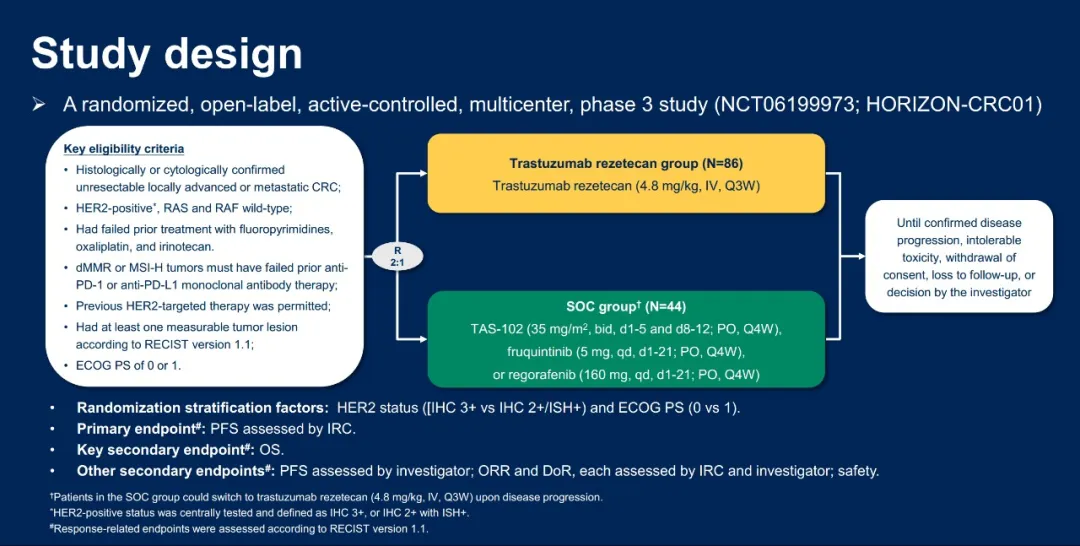
Key Eligibility Criteria:
- Histologically or cytologically confirmed unresectable locally advanced or metastatic CRC
- HER2-positive (IHC 3+ or IHC 2+/ISH+); RAS and RAF wild-type
- Prior failure with fluoropyrimidines, oxaliplatin, and irinotecan
- dMMR or MSI-H tumors must have failed prior anti-PD-1 or anti-PD-L1 monoclonal antibody therapy
- Previous HER2-targeted therapy permitted; at least one measurable lesion per RECIST v1.1
- ECOG PS of 0 or 1
Treatment Arms: Trastuzumab rezetecan 4.8 mg/kg IV every 3 weeks (N=86) vs. Standard-of-care (TAS-102, fruquintinib, or regorafenib; N=44). Randomization stratified by HER2 status (IHC 3+ vs IHC 2+/ISH+) and ECOG PS (0 vs 1).
Efficacy Results: A Paradigm Shift
As of October 31, 2025, the median follow-up time was 9.6 months. The results demonstrated a clinically meaningful and statistically significant benefit for trastuzumab rezetecan:
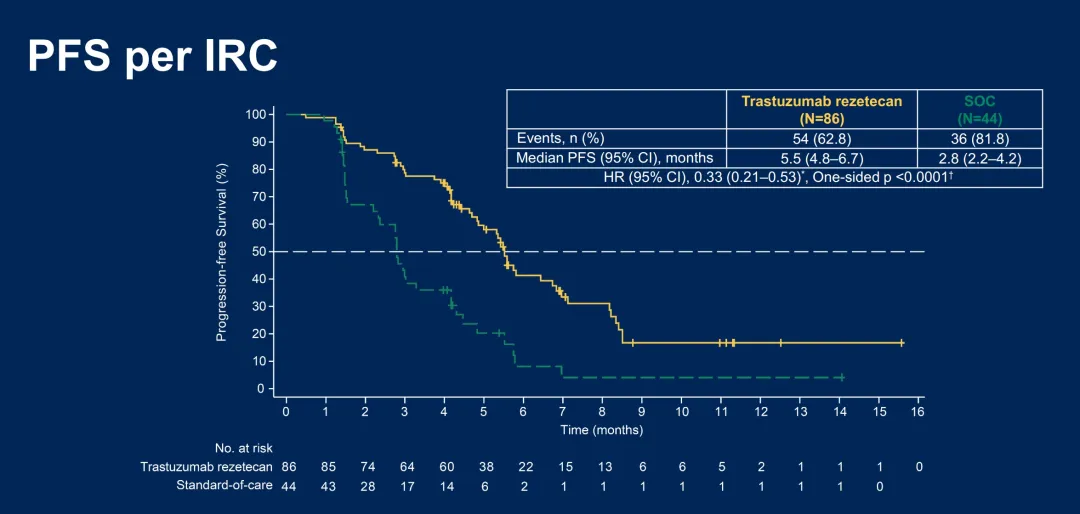
Key Efficacy Findings:
- Median PFS (IRC): 5.5 months (trastuzumab rezetecan) vs. 2.8 months (SOC); HR 0.33 (95% CI 0.21-0.53); one-sided p < 0.0001. Disease progression risk reduced by 67%.
- ORR (IRC): 40.7% (trastuzumab rezetecan) vs. 4.5% (SOC).
- Overall Survival: Median OS not yet reached in either arm due to short follow-up; a favorable trend observed with HR 0.77 (23% reduction in risk of death).
- Subgroup consistency: PFS benefit was consistent across all prespecified subgroups.
Prof. Li Jin emphasized that one of the greatest significances of HORIZON-CRC01 lies in being the first Phase 3 randomized controlled trial to provide high-level evidence-based medicine specifically for Chinese patients with HER2-positive mCRC. Earlier studies such as MOUNTAINEER and DESTINY-CRC were Phase 2 exploratory trials and did not include Chinese patient data. HORIZON-CRC01 fills this critical gap and may strongly drive the evolution of HER2-positive mCRC treatment in China.
Safety: Manageable Profile, No ILD Observed
Beyond efficacy, the safety of HER2-targeted ADCs draws particular attention, especially regarding interstitial lung disease (ILD). According to Prof. Li Jin, the overall safety profile of trastuzumab rezetecan in HORIZON-CRC01 was generally controllable. Most adverse events were monitorable and intervenable, with no new safety signals identified.
The incidence of Grade 3 or higher treatment-related adverse events (TRAEs) was 48.8% in the trastuzumab rezetecan group, predominantly hematologic toxicities including decreased neutrophil count, decreased white blood cell count, and anemia, consistent with the known safety profile of ADC agents. The SOC group had a Grade 3+ TRAE rate of 50.0%. Notably, no ILD events were observed, and no patient discontinued treatment due to TRAEs.
Prof. Li Jin stressed that vigilance must still be maintained during ADC therapy. When Grade 3 or above adverse reactions occur, timely management and appropriate dose reduction are essential so that patients can continue treatment under relatively safe conditions. The key principles for safety management are early screening, early recognition, and early intervention. Baseline pulmonary assessment should be performed before treatment to identify high-risk factors, followed by enhanced symptom monitoring and imaging follow-up during treatment, with particular attention to early signals such as cough and shortness of breath. Once ILD is suspected, treatment should be promptly suspended and intervention initiated according to severity.
Clinical Impact and Future Directions
Based on the HORIZON-CRC01 results, the New Drug Application (NDA) for trastuzumab rezetecan in HER2-positive mCRC has been accepted by China's Center for Drug Evaluation (CDE) and granted priority review. Additionally, trastuzumab rezetecan has received a Level III recommendation in the CSCO Colorectal Cancer Diagnosis and Treatment Guidelines (2026 Edition). As these clinical evidence and guideline recommendations gradually take effect, patients with HER2-positive mCRC in China are expected to gain access to truly accessible, standardized anti-HER2 treatment options.
Moving Toward Earlier Lines of Therapy
Prof. Li Jin views the release of HORIZON-CRC01 not as an endpoint but as a new beginning. One of the most promising future directions is moving HER2 ADC therapy forward to earlier treatment lines. Historically, HER2-targeted research in mCRC focused on later-line settings after standard therapy failure. The success of HORIZON-CRC01 has now clearly validated the clinical value of HER2 ADCs in this population.
Prof. Li Jin proposed a clinically insightful approach: using HER2 ADC to replace traditional irinotecan-based regimens in second-line treatment. Current irinotecan combinations typically achieve a PFS of around 4 months in the second-line setting, while trastuzumab rezetecan monotherapy already reached a median PFS of 5.5 months in the third-line setting. There is therefore strong rationale to expect even better outcomes when the agent is moved earlier, particularly when patients are in better physical condition.
This potential is further supported by the unique payload design of trastuzumab rezetecan. It employs a structurally modified novel topoisomerase I inhibitor called ruze-tecan, which differs meaningfully from SN-38, the active metabolite of irinotecan. Some prior ADCs used SN-38 as their payload and faced potential cross-resistance after irinotecan failure. Through payload modification, trastuzumab rezetecan may overcome irinotecan resistance to a meaningful degree. Prof. Li Jin noted that some patients who had not responded to irinotecan still showed clear efficacy after receiving trastuzumab rezetecan, demonstrating a differentiated advantage over prior HER2 ADCs and other ADC products.
However, moving HER2 ADCs to earlier lines does not simply mean replicating later-line strategies. More rigorous exploration of combination approaches will be required. Future strategies may include combining HER2 ADCs with fluoropyrimidines, capecitabine, and anti-angiogenic therapies. Whether dose reductions are needed after combination and whether toxicity can be controlled will require further clinical validation.
First-Line Combination Data: SHR-A1811-208
Also at this year's ASCO meeting, early data from the SHR-A1811-208 study exploring trastuzumab rezetecan combined with bevacizumab and chemotherapy as first-line therapy for HER2-positive mCRC were disclosed. Preliminary results showed that in the HER2-positive subgroup (IHC 3+ or IHC 2+/ISH+), the confirmed ORR reached 90.5% and the 12-month PFS rate was 94.7%, demonstrating highly encouraging anti-tumor activity and controllable safety.
Conclusion
The publication of HORIZON-CRC01 brings the first Phase 3 randomized controlled trial evidence to HER2-positive mCRC and further advances HER2 ADC therapy in colorectal cancer toward a more standardized and systematic stage of precision treatment. With the continued emergence of clinical value from next-generation HER2 ADCs such as trastuzumab rezetecan, and with ongoing deepening of research into earlier-line and combination strategies, patients with HER2-positive mCRC can look forward to more precise, effective, and accessible treatment choices in the near future. At the same time, original Chinese research represented by HORIZON-CRC01 taking the international academic stage is contributing increasingly important Chinese experience and solutions to global HER2-positive mCRC precision treatment.
About the Principal Investigator
Prof. Li Jin (李进)
President, Shanghai GOBROAD Cancer Hospital (China Pharmaceutical University Affiliated)
Lifetime Professor, Tongji University Affiliated Shanghai East Hospital
Clinic Schedule: Every Monday All Day, Thursday Morning, Saturday Morning
Specialization: Prof. Li focuses on digestive system malignancies, with expertise in molecular targeted therapy, immunotherapy, investigational new drug clinical trials, and multidisciplinary team discussions for complex solid tumors, particularly gastric cancer and colorectal cancer.
Academic appointments: President, Asian Federation of Medical Oncology (FACO); Chairman, CSCO Colorectal Cancer Expert Committee; Director-General, National Health Commission Center for Capacity Building and Continuing Education; Chairman, Beijing CSCO Clinical Oncology Research Foundation; Vice-Chairman, Chinese Medical Continuing Education Association Abdominal Oncology Committee; Chairman, Shanghai Waigaoqiao Cell and Gene Therapy Industry Alliance; Deputy Editor-in-Chief, Cancer Science.
Learn More or Enroll
If you are interested in learning more details about this clinical trial or other advanced treatment options at GOBROAD hospitals, please contact us. We strictly protect your personal information in accordance with applicable regulations.