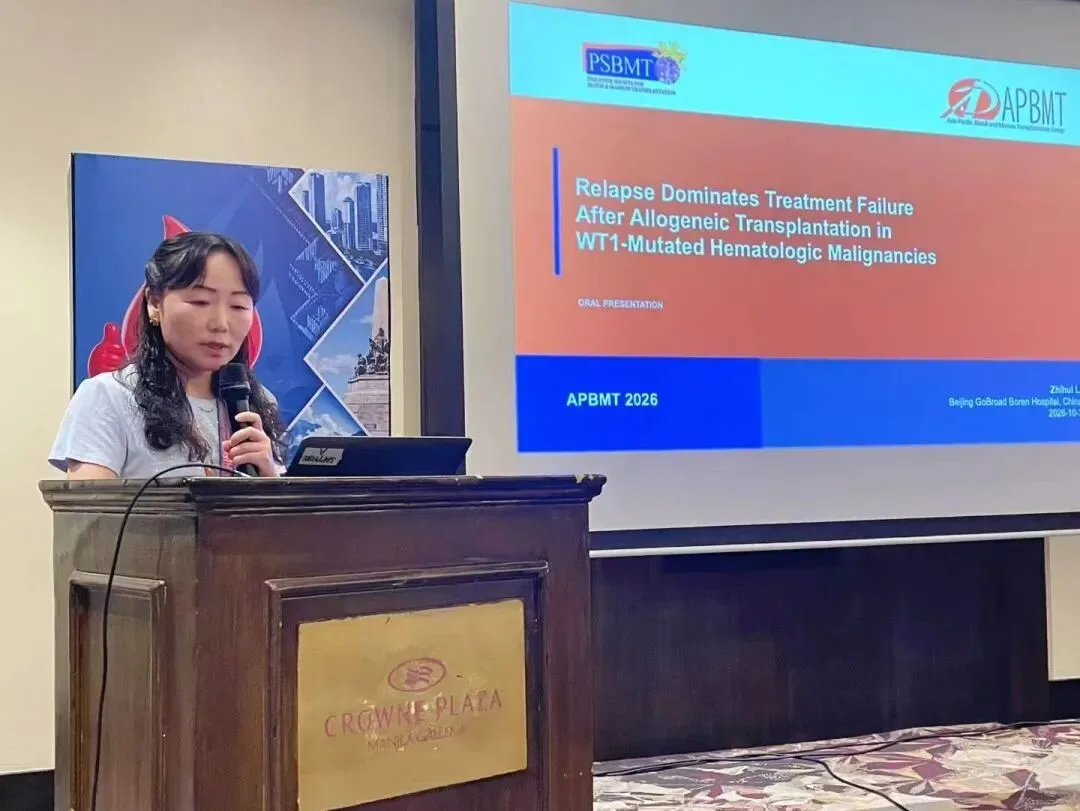
At the 31st Annual Meeting of the Asia-Pacific Blood and Marrow Transplantation Group (APBMT 2026), held in Manila, Philippines from October 1 to 4, a study from the team of Prof. Wu Tong and Dr. Li Zhihui at Beijing GOBROAD Boren Hospital was selected for an oral presentation. The study examined relapse after allogeneic hematopoietic stem cell transplantation (allo-HSCT) in patients with WT1-mutated hematologic malignancies, and identified the key factors that shape transplant outcomes.
The oral abstract, titled "Relapse Dominates Treatment Failure After Allogeneic Transplantation in WT1-Mutated Hematologic Malignancies," was presented by Dr. Li Zhihui as first author, with Prof. Wu Tong as corresponding author.
A Seven-Year Cohort of 53 Patients
The study retrospectively enrolled 53 patients with WT1-mutated hematologic malignancies who underwent hematopoietic stem cell transplantation at Beijing GOBROAD Boren Hospital between January 2019 and December 2025. WT1 variants were classified according to mutation consequence, codon position and variant allele frequency (VAF), and the presence of two or more annotated WT1 mutations was defined as multiple-hit WT1 (mhWT1).
Median age was 32 years at diagnosis and 34 years at allo-HSCT, and 28 patients (52.8%) were male. Acute myeloid leukemia (AML) was the most common diagnosis, in 34 patients (64.2%), followed by B-cell acute lymphoblastic leukemia (B-ALL, 11.3%), myelodysplastic syndrome or AML (MDS/AML, 5.7%) and T-lymphoblastic lymphoma (T-LBL, 5.7%).
The median interval from diagnosis to allo-HSCT was 17.2 months. At transplant, 41 patients (77.4%) were in complete remission or had no morphologic disease, while 12 patients (22.6%) had active disease. Among 51 evaluable patients, 32 (62.7%) were minimal residual disease (MRD) positive, and 48 patients (90.6%) received a reduced-intensity conditioning regimen.
The Genetic Landscape: One Third Carried Multiple WT1 Hits
Detailed WT1 mutation data were available for 49 patients: 18 (36.7%) carried mhWT1 and 31 (63.3%) carried a single WT1 mutation. A total of 73 WT1 variants were detected, comprising 49 frameshift mutations (67.1%), 11 nonsense mutations (15.1%), 9 missense or in-frame mutations (12.3%) and 4 splice or unknown-significance variants (5.5%). The median maximum WT1 VAF was 33.6%, and mutations clustered mainly at codons 380 to 382.
Co-mutations were present in 47 of the 49 patients (95.9%). The most frequently co-mutated genes were CEBPA, NOTCH1, NRAS, FLT3, GATA2 and PHF6. The presence of mhWT1 was associated with an AML diagnosis (83.3% versus 48.4%, P = 0.018) and with pre-transplant MRD positivity (83.3% versus 51.7%, P = 0.034).
Relapse Outweighs Non-Relapse Mortality
After a median follow-up of 31 months, 21 of 52 evaluable patients (40.4%) relapsed and 23 of 48 patients (47.9%) died. The cumulative incidence of relapse was 8.4% at day 100, 39.0% at one year and 43.6% at three years, while non-relapse mortality (NRM) was 7.9%, 12.1% and 16.9% at the same time points.
Median progression-free survival (PFS) was 14 months, with one-year and three-year PFS of 51.0% and 38.7%. Median overall survival (OS) was 42 months, with one-year and three-year OS of 77.1% and 62.1%.
Which Patients Face the Highest Risk?
Compared with patients carrying a single WT1 mutation, those with mhWT1 had higher one-year and three-year cumulative incidence of relapse (49.9% and 56.3% versus 31.2% and 35.4%) and shorter median PFS (7 months versus 24 months). However, mhWT1 was not an independent predictor of relapse, PFS or OS on multivariable analysis.
Independent risk signals did emerge elsewhere. GATA2 co-mutation predicted relapse (hazard ratio [HR] = 3.79, P = 0.026), and myeloablative conditioning was associated with worse PFS (HR = 6.70, P = 0.002) and worse OS (HR = 5.98, P = 0.016).
What This Means for Post-Transplant Care
The team concluded that relapse after allo-HSCT is common in patients with WT1 mutations, and that relapse — rather than non-relapse mortality — is the dominant mode of treatment failure. Multiple-hit WT1 showed an unfavourable numeric trend but was not an independent prognostic factor, whereas GATA2 co-mutation and conditioning intensity did identify higher-risk subgroups.
For clinical practice, the findings support closer MRD and mutation monitoring in the first year after transplant, when the relapse curve rises most steeply, and more individualised choices of conditioning intensity for patients carrying WT1 mutations.
This article is a conference report based on the oral abstract presented by Dr. Li Zhihui on behalf of Beijing GOBROAD Boren Hospital at APBMT 2026. It is intended for general informational purposes only and does not constitute medical advice, diagnosis, or treatment. Please consult a qualified physician for any medical decision.