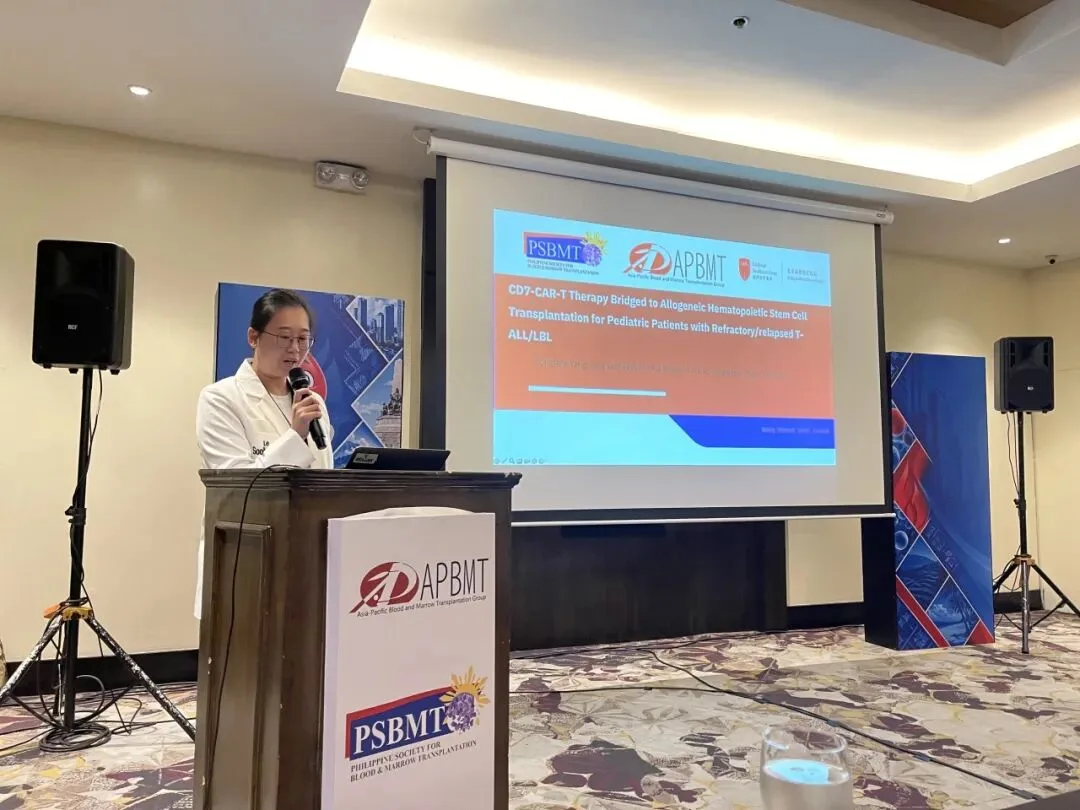
At the 31st Annual Meeting of the Asia-Pacific Blood and Marrow Transplantation Group (APBMT 2026), held in Manila, Philippines from October 1 to 4, Dr. Yang Dongfang of the team of Prof. Wu Tong and Dr. Zhao Yongqiang at Beijing GOBROAD Boren Hospital gave an oral presentation on CD7 CAR-T therapy followed by allogeneic hematopoietic stem cell transplantation (allo-HSCT) in children with relapsed or refractory T-cell acute lymphoblastic leukemia (T-ALL) or T-lymphoblastic lymphoma (T-LBL).
The study explored whether a sequential CAR-then-transplant strategy can improve the long-term outlook for these children, whose prognosis with CD7 CAR-T therapy alone remains poor.
23 Children Bridged from CAR-T to Transplant
The study enrolled 23 children with relapsed or refractory T-ALL/LBL who received CD7 CAR-T therapy followed by allo-HSCT in the hospital's transplant department between July 2022 and December 2025. Median age was 11 years (range 4 to 17), with 20 boys and 3 girls.
Seventeen patients (73.9%) received autologous-derived CD7 CAR-T cells and 6 patients (26%) received donor-derived CD7 CAR-T cells. Three patients underwent a second allo-HSCT. After CAR-T therapy, 18 patients (78%) achieved complete remission (CR), while 5 patients (21%) remained in a non-remission (NR) state.
Transplant types were haploidentical in 15 patients (65.2%) and unrelated donor in 8 patients (34.7%). Conditioning was TBI/FLU-based in 21 patients (91.3%) and BU/FLU-based in 2 patients (8.6%). Graft-versus-host disease (GVHD) prophylaxis used cyclosporine, mycophenolate mofetil and short-course methotrexate.
Engraftment and Post-Transplant Complications
All patients achieved full donor chimerism. Median time to neutrophil engraftment was day 14 after transplant (range 10 to 22 days) and median time to platelet engraftment was day 13 (range 9 to 25 days).
Viral infections after HSCT occurred in 16 patients (69.5%), including cytomegalovirus (CMV) in 7 patients (30.4%), Epstein-Barr virus (EBV) in 4 patients (17.3%), adenovirus (ADV) in 4 patients (17.3%) and other viral infections in 3 patients (13%). Other complications included hemorrhagic cystitis in 8 patients (34.7%), thrombotic microangiopathy (TMA) in 2 patients (8.6%), and bacterial or fungal infections in 11 patients (47.8%).
Survival Outcomes at Two Years
After a median follow-up of 23 months (range 6 to 45 months), one-year and two-year overall survival (OS) were both 95.65%. One-year and two-year relapse-free survival (RFS) were 91.30% and 84.78% respectively. The cumulative incidence of relapse and the transplant-related mortality (TRM) rate were both 8.7%.
What the Study Adds
The team concluded that children with relapsed or refractory T-ALL/LBL can achieve favourable relapse-free survival when CD7 CAR-T therapy is bridged to allo-HSCT. Importantly, patients who were still in a non-remission state after CAR-T therapy also derived a survival benefit from subsequent allo-HSCT.
The study also flagged a practical caution: the incidence of viral infection after HSCT in this sequence is relatively high, so close monitoring and prompt treatment are essential. Because the sample size is small, the findings need to be confirmed in further studies.
This article is a conference report based on the oral abstract presented by Dr. Yang Dongfang on behalf of Beijing GOBROAD Boren Hospital at APBMT 2026. It is intended for general informational purposes only and does not constitute medical advice, diagnosis, or treatment. Please consult a qualified physician for any medical decision.