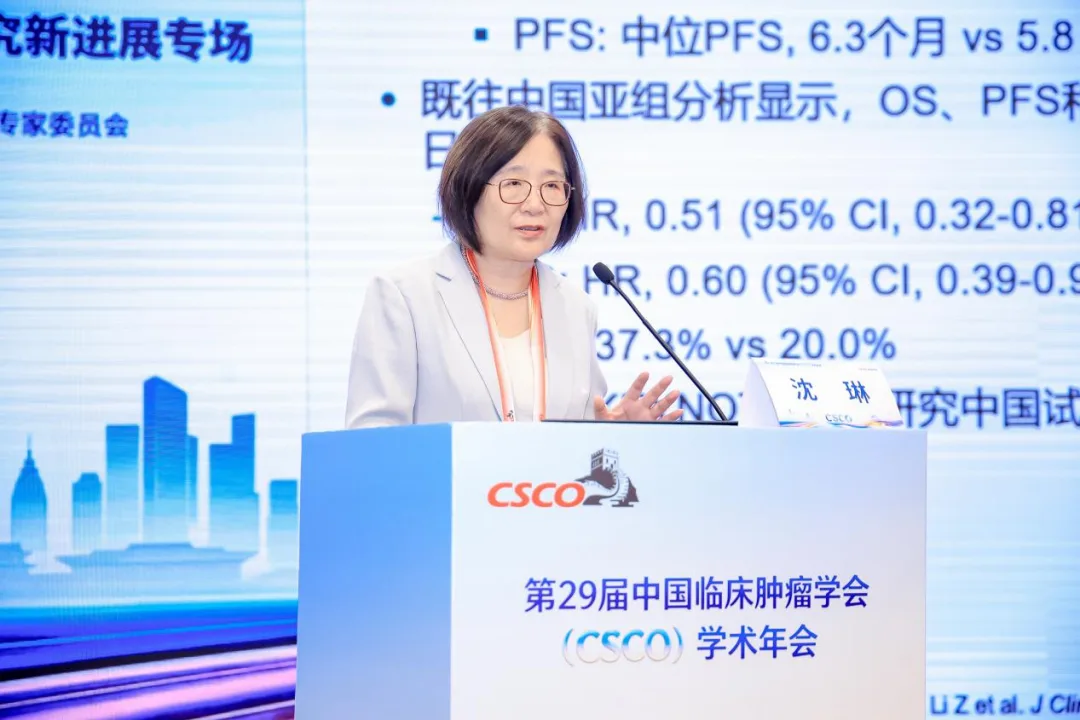
At the 29th Annual Academic Conference of the Chinese Society of Clinical Oncology (CSCO), Prof. Shen Lin of Peking University Cancer Hospital and Beijing GOBROAD Hospital presented the 5-year follow-up results of the Chinese patient population from the KEYNOTE-590 phase III study — one of the award-winning studies of this year's conference. These long-term data not only reveal the durable survival benefit of immunotherapy combined with chemotherapy in Chinese patients with esophageal cancer, but also offer new thinking on the design of long-term follow-up in clinical research.
106 Chinese Patients Answer the Long-Term Follow-Up Question
KEYNOTE-590 is a global, multicentre, randomised, double-blind, placebo-controlled phase III study that enrolled 749 patients with unresectable locally advanced or metastatic esophageal cancer and gastroesophageal junction cancer. Patients were randomised 1:1 to receive pembrolizumab in combination with cisplatin and 5-fluorouracil (5-FU), or placebo in combination with chemotherapy. Stratification factors included histology (squamous or adenocarcinoma), region (Asian or non-Asian) and Eastern Cooperative Oncology Group (ECOG) performance status (0 or 1).
The Chinese subgroup comprised 106 patients — 51 in the experimental arm and 55 in the control arm — with balanced baseline characteristics. Previously reported Chinese subgroup results showed a median overall survival (OS) of 10.5 months in the experimental arm versus 8.0 months in the control arm (hazard ratio [HR] = 0.51, 95% confidence interval [CI] 0.32–0.81), and a median progression-free survival (PFS) of 6.2 months versus 4.6 months (HR = 0.60, 95% CI 0.39–0.92). The core of this presentation was to unveil the long-term follow-up results on that basis.
Alarm Bell: Does a Study End When the Primary Endpoint Is Met?
Prof. Shen Lin pointed out that many domestic clinical studies end as soon as the primary endpoint is reached. When investigators later want to trace three- or five-year survival rates, they often have no way to proceed — follow-up has stopped, and patient data across centres are difficult to verify one by one, so the long-term data are simply lost. By contrast, comparable international studies keep reporting survival rates every two to five years, allowing the research to be presented repeatedly and the value of the drug to be fully demonstrated.
This contrast suggests that, going forward, long-term follow-up should be written into study design as a mandatory requirement, rather than requested as an afterthought once the study has ended.
Long-Tail Effect: At 48 Months, 16% of Patients Are Still Alive
Prof. Shen Lin emphasised that interpreting such studies should not focus only on the absolute difference in median survival, but should pay more attention to the magnitude of risk reduction reflected by the HR. In the Chinese intention-to-treat (ITT) population, the OS HR was 0.52 — the risk of death nearly halved — showing that the advantage of combination therapy over chemotherapy alone holds even in a small sample, and that the value of clinical research must ultimately return to the data itself.
What deserves more attention is the "long-tail effect" of long-term survival. OS rates at each time point show that the gap between the experimental and control arms widens over time:
- 12-month OS rate: 45% in the experimental arm versus 27% in the control arm;
- 24-month OS rate: 26% versus 7%;
- 36-month OS rate: 20% versus 2%;
- 48-month OS rate: 16% versus 0%.
The separation trend at the tail of the survival curve is very clear. This is highly similar to the long-term benefit of immunotherapy observed in gastric cancer, indicating that the long-term survival benefit that immunotherapy brings to esophageal cancer patients is real — it is simply manifested more in the far-end tailing curve than in a large gap in the median value.
PD-L1: Can Stratify, but Not "One Size Fits All"
In the long-term analysis of the Chinese ITT population, the low programmed death-ligand 1 (PD-L1) expression population also showed a trend toward OS benefit. Prof. Shen Lin believes that the interpretation of PD-L1 needs to be more cautious: in esophageal cancer, it can serve as a stratification reference, but is not sufficient to be the sole selection criterion; nor should evaluation focus only on the absolute value of the HR — the span of the 95% CI matters more. The wider the span, the less stable the result and the lower the credibility; only when the entire confidence interval lies below 1.0 is the conclusion of higher value.
Therefore, whether low PD-L1-expression populations are suitable for immunotherapy still requires more studies for continued observation. This also shows that the same set of study data, interpreted in different ways, can lead to very different clinical implications.
Moving Forward: From One Dataset to a Template
Prof. Shen Lin summarised that the three most important contributions of this study are:
First, every clinical trial should incorporate long-term survival into its considerations — immunotherapy can enable a subset of patients to achieve long-term survival and even cure, which was previously difficult to attain;
Second, long-term follow-up and specimen retention must be agreed upon at the study design stage, rather than remedied after the study ends;
Third, evaluation of efficacy should focus on the survival rate at each time node and the HR value, rather than merely comparing median values.
In summary, the long-term follow-up data of the Chinese ITT population in the KEYNOTE-590 study confirm the long-term survival value of immunotherapy combined with chemotherapy, and also provide a template for the follow-up design of domestic clinical research.
This article is a press summary based on the official CSCO 2026 conference information and publicly released results of the KEYNOTE-590 China cohort presented by Prof. Shen Lin. It is intended for general informational purposes only and does not constitute medical advice, diagnosis, or treatment. Please consult a qualified physician for any medical decision.