
Gastric Cancer, Peritoneal Metastasis, and the Promise of CLDN18.2-Targeted Therapy
Gastric cancer remains one of the most common malignancies worldwide. In China, the disease burden is particularly heavy — approximately 42% of patients are already at an advanced stage at diagnosis, and the 5-year overall survival rate for Stage IV patients is only 13.15%. Among all patterns of disease progression, peritoneal metastasis represents one of the most challenging forms: prognosis is poor, and conventional treatments have limited efficacy.
With the continued advancement of precision medicine, biomarker-driven treatment decisions are gaining increasing importance. Claudin 18.2 (CLDN18.2) has emerged as a promising therapeutic target due to its high and stable expression in gastric cancer. Notably, research shows that CLDN18.2-positive patients are more likely to develop peritoneal metastasis compared with negative patients, and CLDN18.2 expression remains stable between primary and metastatic sites throughout disease progression. This biological characteristic means that CLDN18.2-targeted drugs can precisely identify and act on tumor cells within peritoneal metastatic deposits — providing a solid foundation for overcoming this historically refractory condition.
Satri-cel injection (CT041) is an independently developed CLDN18.2-targeted CAR T-cell product built on this target. As the world's first approved CAR-T therapy for solid tumors, it has opened an entirely new treatment pathway for patients with advanced gastric cancer. With its precise targeting capability, this therapy is demonstrating substantial therapeutic potential even in the highly difficult domain of gastric cancer with peritoneal metastasis.
Published Case: 48 Months of Sustained Peritoneal Control
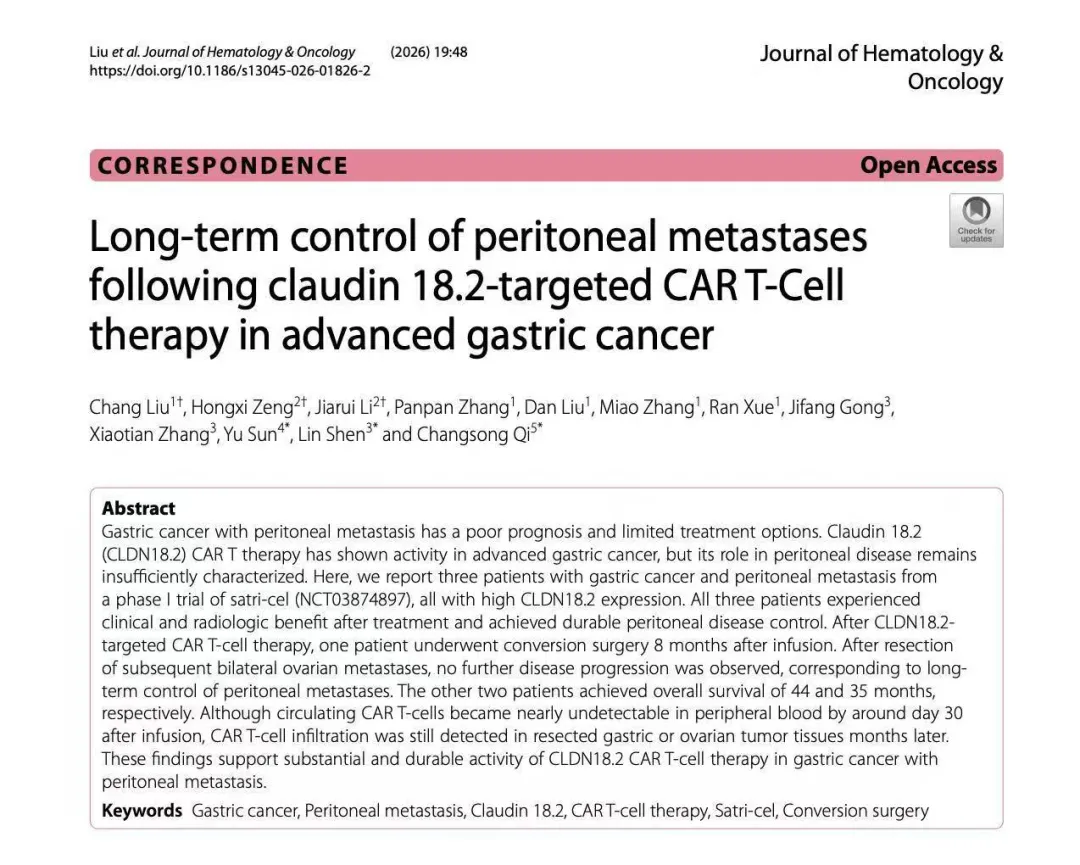
This article shares a representative case published in the international peer-reviewed journal Journal of Hematology & Oncology, with expert commentary provided by Professor Qi Changsong of Peking University Cancer Hospital and Beijing GOBROAD Hospital. The case originates from the CT041-CG4006 clinical trial, in which the patient received first-line chemotherapy followed by sequential satri-cel maintenance therapy. Within only 8 months after the first infusion, the Peritoneal Carcinomatosis Index (PCI) dropped from 9 points to 0, and the patient successfully underwent conversion surgery. Since the first infusion, peritoneal metastasis has been continuously controlled for 48 months.
Patient Profile and Prior Treatment
Patient: Female, 53 years old. Diagnosis: gastric cancer with peritoneal metastasis.
The patient received 6 cycles of first-line chemotherapy (paclitaxel, oxaliplatin combined with oral S-1). Abdominopelvic CT evaluation showed stable disease (SD). After multidisciplinary team (MDT) discussion, a diagnostic laparoscopy was performed on June 1, 2021. Intraoperative findings revealed multiple peritoneal implantation lesions in the pelvic cavity, with a PCI score of 9. Biopsy pathology confirmed metastatic signet-ring cell carcinoma. The patient received intraperitoneal hyperthermic perfusion chemotherapy (HIPEC) with docetaxel during surgery, followed by 4 additional cycles of intraperitoneal paclitaxel combined with oral S-1.
Subsequent immunohistochemical testing confirmed that the tumor showed high CLDN18.2 expression (IHC 3+, 90%). After thorough communication, the patient consented to enroll in the CT041-CG4006 study's cohort for sequential satri-cel maintenance therapy following first-line induction treatment.
Treatment Course and Clinical Outcomes
To prepare CAR-T cells, the patient underwent leukapheresis on November 16, 2021, with one cycle of S-1 bridging therapy administered beforehand. Prior to satri-cel infusion, lymphodepletion conditioning consisted of fludarabine, cyclophosphamide, and nab-paclitaxel.
The patient received the first satri-cel infusion on December 20, 2021 (dose: 250 x 106 cells).
Key Milestones:
- Week 4 post-infusion: Partial response (PR) achieved; peritoneal nodules reduced in size.
- August 4, 2022 (7 months post-infusion): CT confirmed sustained PR on restaging.
- September 1, 2022 (8 months post-infusion): Diagnostic laparoscopy revealed no visible metastatic deposits on peritoneum, omentum, or mesentery — PCI score 0. The patient underwent total gastrectomy + D2 lymphadenectomy. Postoperative pathology: ypT2N0.
- January 9, 2023: Follow-up CT indicated bilateral ovarian enlargement.
- February 2, 2023 (13 months post-infusion): Laparoscopy confirmed bilateral ovarian metastatic Krukenberg tumors; no recurrence observed in other peritoneal regions. Bilateral salpingo-oophorectomy performed.
- May 29, 2023: Second satri-cel infusion administered.
- As of January 6, 2026: No further disease progression observed. Peritoneal metastasis has been controlled for 48 months since the first satri-cel infusion.
Safety Profile
Throughout the treatment period, no immune effector cell-associated neurotoxicity syndrome (ICANS) or grade ≥3 cytokine release syndrome (CRS) was observed. The safety profile was favorable and well tolerated.
CAR-T Cell Detection in Peripheral Blood and Tumor Tissue
CAR-T cell copy numbers in peripheral blood peaked around day 10 post-infusion and became nearly undetectable by day 30. However, CAR-T cells were detected in both the gastric tissue resected at 8 months post-infusion and the ovarian tissue resected at 13 months, indicating that CAR-T cells persist within tumor tissues over the long term and may provide ongoing immune surveillance at the local level.
Expert Commentary I: From Peritoneal Control to Conversion Surgery and Long-Term Survival
Professor Qi Changsong provides the following analysis:
This case involves a patient with initially unresectable gastric cancer accompanied by peritoneal metastasis. After first-line chemotherapy, biomarker testing confirmed high CLDN18.2 expression, and the patient enrolled in the CT041-CG4006 study to receive satri-cel maintenance therapy. Remarkably, from the first infusion to January 6, 2026, the patient's peritoneal metastasis has been under continuous control for 48 months — truly achieving long-term survival.
Peritoneal metastasis is one of the most challenging patterns of distant spread in gastric cancer. Currently, the efficacy of immunotherapy in gastric cancer patients with peritoneal metastasis remains unclear, and there is a genuine gap in effective targeted therapies. Because CLDN18.2 expression is highly stable and consistent between primary and metastatic sites in gastric cancer, it provides an ideal target for precision targeting.
In this patient, PR was achieved as early as week 4 after satri-cel administration, with reduction of peritoneal nodules. At 8 months, PCI dropped from 9 to 0, enabling successful conversion surgery. Postoperative pathology showed downstaging to ypT2N0 — achieving a therapeutic leap from unresectable to radical resection. Although an isolated ovarian metastasis subsequently appeared, after a second surgery and second CAR-T infusion, no further disease progression has been observed, and peritoneal metastasis has been controlled for 48 months. Throughout the entire course, no ICANS or grade ≥3 CRS occurred, confirming a manageable safety profile. The detection of CAR-T cells in both gastric tissue (at 8 months) and ovarian tissue (at 13 months) confirms their ability to engraft locally in tumor tissue and sustain immunosurveillance function over the long term. This case, from a clinical practice perspective, highlights the substantial therapeutic potential of satri-cel in this highly refractory population.
Expert Commentary II: CT041-CG4006 Study and Confirmatory Evidence
The CT041-CG4006 study[5], to which this case belongs, is a multicenter, open-label Phase I clinical trial led by Professor Shen Lin, systematically evaluating the safety and efficacy of satri-cel in CLDN18.2-positive advanced gastrointestinal malignancies. The study defines CLDN18.2 positivity as membrane staining intensity ≥2+ in ≥40% of tumor cells — a threshold relaxed compared with the 75% cutoff used for previously approved targeted drugs — thereby expanding the potential beneficiary population from approximately 38% to nearly 70%.
In particular, the latest results for Cohort 3 (sequential satri-cel maintenance after first-line induction, N=5) were presented at ASCO 2026. With over 4.5 years of follow-up data, despite a baseline of 60% Lauren diffuse-type histology, 80% signet-ring cell carcinoma, and 80% with peritoneal metastasis — representing extremely refractory disease — the objective response rate (ORR) among the 4 evaluable patients with target lesions reached 100%, and the median progression-free survival (PFS) in the first-line setting reached 20.9 months, with some patients achieving long-term survival. This patient's 48-month tumor control aligns closely with the cohort-level data, revealing the therapeutic potential of satri-cel in the gastric cancer population with peritoneal metastasis.
Furthermore, the confirmatory CT041-ST-01 study has further consolidated its clinical value — in advanced gastric/gastroesophageal junction adenocarcinoma that has failed at least two prior lines of therapy, satri-cel significantly improved ORR, markedly extended median PFS and OS, reduced mortality risk, and demonstrated consistent benefit across all prespecified subgroups, including those with peritoneal metastasis.
From Approval to Broader Horizons
Based on this breakthrough evidence, satri-cel injection has been formally approved in China for the treatment of CLDN18.2-positive, HER2-negative advanced gastric/gastroesophageal junction adenocarcinoma that has failed at least two prior lines of therapy — becoming the world's first CAR-T cell therapy drug for solid tumors, achieving a landmark "zero-to-one" breakthrough in this field. Additionally, the therapy has been incorporated into the CSCO Gastric Cancer Diagnosis and Treatment Guidelines (2026 Edition) as an annotated update, receiving authoritative recognition of its clinical value.
Looking ahead, the exploration of satri-cel is far from over. In terms of timing, moving from later-line treatment to first-line maintenance, neoadjuvant, and perioperative settings may allow more patients to benefit earlier — potentially even achieving curative opportunities. In terms of tumor types, the high expression of CLDN18.2 in pancreatic cancer, biliary tract cancer, and other solid tumors also offers broad scope for expansion. Moreover, for the specifically difficult population of gastric cancer with peritoneal metastasis, satri-cel has shown encouraging preliminary efficacy, bringing new hope to a group with historically very poor long-term prognosis — larger-sample studies are urgently needed to confirm these findings. Overall, satri-cel is transitioning from "later-line rescue" to "multi-scenario deployment," and its clinical value is expected to continue expanding.
About the Featured Expert
Prof. Qi Changsong (齐长松)
Peking University Cancer Hospital & Beijing GOBROAD Hospital
Clinic Schedule: Please contact MedTourChina for availability
Professor / Specialist in Gastrointestinal Oncology & Cellular Therapy
Specialization: Focuses on gastrointestinal malignancies including gastric cancer, colorectal cancer, and gastroesophageal junction adenocarcinoma, with particular expertise in precision oncology, biomarker-driven targeted therapy, CAR-T cell therapy for solid tumors, and clinical trial design. Active investigator in the CT041-CG4006 and CT041-ST-01 trials evaluating CLDN18.2-targeted CAR T-cell therapy in advanced digestive system malignancies.
Learn More or Contact Us
If you or a loved one is facing a diagnosis of advanced gastric cancer, gastroesophageal junction cancer, or other CLDN18.2-positive solid tumor malignancy, and would like to explore innovative treatment options including CAR-T cell therapy, clinical trial enrollment, or specialist consultation at GOBROAD hospitals — please contact us. We strictly protect your personal information in accordance with applicable regulations.