
Why HLA Matching Is the Quiet Determinant of Transplant Success
The human leukocyte antigen (HLA) system is the molecular basis of immune self-recognition — effectively the identity label the immune system uses to distinguish the body's own cells from foreign ones. In haematopoietic stem cell transplantation, how closely donor and recipient HLA types match is one of the key factors determining whether the transplant succeeds and how great the risk of graft-versus-host disease (GVHD) and other complications will be.
HLA is also one of the most polymorphic regions of the human genome, and the pace of new allele discovery has accelerated sharply with the adoption of next-generation sequencing (NGS) and third-generation sequencing (TGS). According to the IPD-IMGT/HLA database (release 3.62), 2486 alleles have already been described at the HLA-DPB1 locus alone. Every newly described and officially named allele adds one more entry to that identity map, improves the accuracy of HLA typing, and gives patients with difficult matching problems one more chance of finding a suitable donor.
Publication in HLA and Official Naming
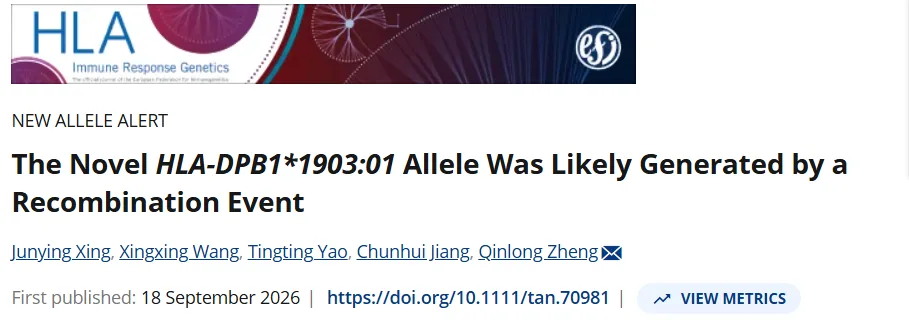
The work, led by Prof. Zheng Qinlong's team at the GOBROAD Diagnostic Centre, was published in the journal HLA: Immune Response Genetics as “The Novel HLA-DPB1*1903:01 Allele Was Likely Generated by a Recombination Event”. Laboratory technologist Xing Junying is first author and Prof. Zheng Qinlong is corresponding author.
The study identified and characterised a completely new HLA-DPB1 allele. In November 2025 the WHO HLA System Nomenclature Committee formally designated it HLA-DPB1*1903:01, and the sequence has been submitted to the IPD-IMGT/HLA database, the global reference resource for HLA sequences.
A Sequence Assembled From Two Known Alleles
The work started from a peripheral blood sample from a healthy donor. Genomic DNA was extracted with the TIANamp Blood DNA Kit, and a commercial HLA typing kit was used to amplify the full-length gene fragments of HLA-A, HLA-B, HLA-C, HLA-DQB1, HLA-DRB1 and HLA-DPB1. The amplicons were sequenced on the Qcell-384 nanopore platform, and raw data were analysed with the QPreasy-NF pipeline (v2.5.32) and compared against IPD-IMGT/HLA v3.59 to assign alleles. The result was an allele that had never previously been characterised.
Sequence alignment then revealed the likely origin. The new allele appears to have arisen from a recombination event between two known alleles, HLA-DPB1*17:01:01 and HLA-DPB1*19:01:01. Positions 1 to 5173 of the genomic sequence are identical to DPB1*17:01:01, and positions 4851 to 10136 are identical to DPB1*19:01:01. The overlap between positions 4851 and 5173 — the region shared by both parental alleles — marks where the recombination is likely to have occurred.
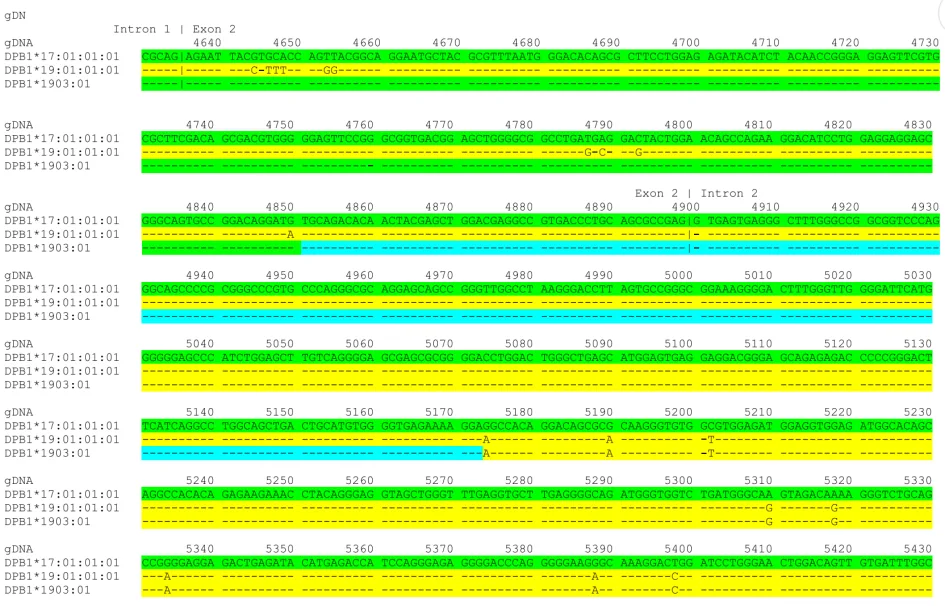
On that basis the team concluded that the new allele was most probably generated by recombination between the two known sequences — a concrete example of one of the mechanisms by which HLA polymorphism arises.
Independent Confirmation and Entry Into Global Databases
To confirm the finding, the team re-typed the sample with an independent next-generation sequencing method: the NGSgo-AmpX v2 kit on the Illumina MiSeq platform, with analysis in NGSengine (GenDx v2.25.0) against IPD-IMGT/HLA v3.60. The NGS result matched the original third-generation sequencing identification exactly, confirming that the novel allele had genuinely been detected.
The sequence was deposited in GenBank (accession PX211065) and submitted to IPD-IMGT/HLA (submission HWS10101389). In November 2025 the WHO HLA System Nomenclature Committee formally assigned the name HLA-DPB1*1903:01; under WHO naming policy, a newly characterised sequence receives its official designation on acceptance and is subsequently reported in the WHO nomenclature report.
Why a Single New Allele Matters Clinically
Accurate HLA allele identification feeds directly into donor selection, post-transplant chimerism monitoring and assessment of transplant-related complication risk. Each newly characterised allele has concrete value in three respects.
It enriches the global database. Every formally named allele increases the resolution of the worldwide matching system, particularly for populations whose HLA diversity is under-represented in older reference data.
It makes matching more precise. Once a rare sequence is registered, laboratories anywhere can recognise and report it correctly instead of recording an ambiguous or unmatched result, making donor-recipient matching more reliable.
It demonstrates the clinical value of integrated diagnostics. From sustained investment in sequencing technology to the discovery and naming of a new allele, what this represents is the systematic capability of a molecular diagnostics laboratory working as the quiet guarantor behind every transplant. Only when the genetic detail is seen clearly enough can each clinical decision be made with confidence.
The work began with a result that did not fit during routine typing and ended with publication in an international journal and formal naming in the global reference database. It reflects another step in the long accumulation of HLA typing expertise at the molecular diagnostics laboratory of Beijing GOBROAD Boren Hospital. The team will continue to build on third-generation sequencing platforms in integrated diagnostics for haematological disease.
Reference
- Xing J, Wang X, Yao T, Jiang C, Zheng Q. The Novel HLA-DPB1*1903:01 Allele Was Likely Generated by a Recombination Event. HLA. 2026. DOI: 10.1111/tan.70981.
- IPD-IMGT/HLA Database, release 3.62.
About the Research Team
Prof. Zheng Qinlong (郑勤龙)
Director, Molecular Diagnostics Laboratory, GOBROAD Diagnostic Centre
Member, Integrated Diagnostics Expert Panel, GOBROAD Medical Group
Member of the 13th Clinical Laboratory Medicine Committee of the Beijing Medical Association; member of the American Association for Cancer Research. Bachelor of Medicine, Shanghai Medical University; postdoctoral fellow at the Health Sciences Center of the University of Oklahoma.
Experience: More than 30 years of laboratory testing and research in cancer and other diseases, covering risk assessment, early diagnosis, prognosis, drug screening and pharmacodynamic monitoring. He has worked at the University of Oklahoma Health Sciences Center, the Department of Clinical Pathology and Laboratory Medicine at UCLA, the US National Cancer Institute, and Nordic Bioscience (Beijing) and its international biochemical pathology research centre.
Xing Junying (邢军英)
Team Leader, Molecular Diagnostics Laboratory, GOBROAD Diagnostic Centre
Intermediate supervising laboratory technologist; Bachelor of Medical Laboratory Science, Peking University.
Experience: 16 years of laboratory testing and research in cancer and other diseases, with particular depth in HLA genotyping. Previously at Beijing Healthstar Medical Laboratory and the Molecular Diagnostics Laboratory of Beijing GOBROAD Boren Hospital.
Learn More or Contact Us
If you would like to know more about the diagnostic pathways, treatment options or clinical studies described in this article, our international patient team can help you understand what is available at GOBROAD hospitals. Your personal information is protected in accordance with applicable regulations.