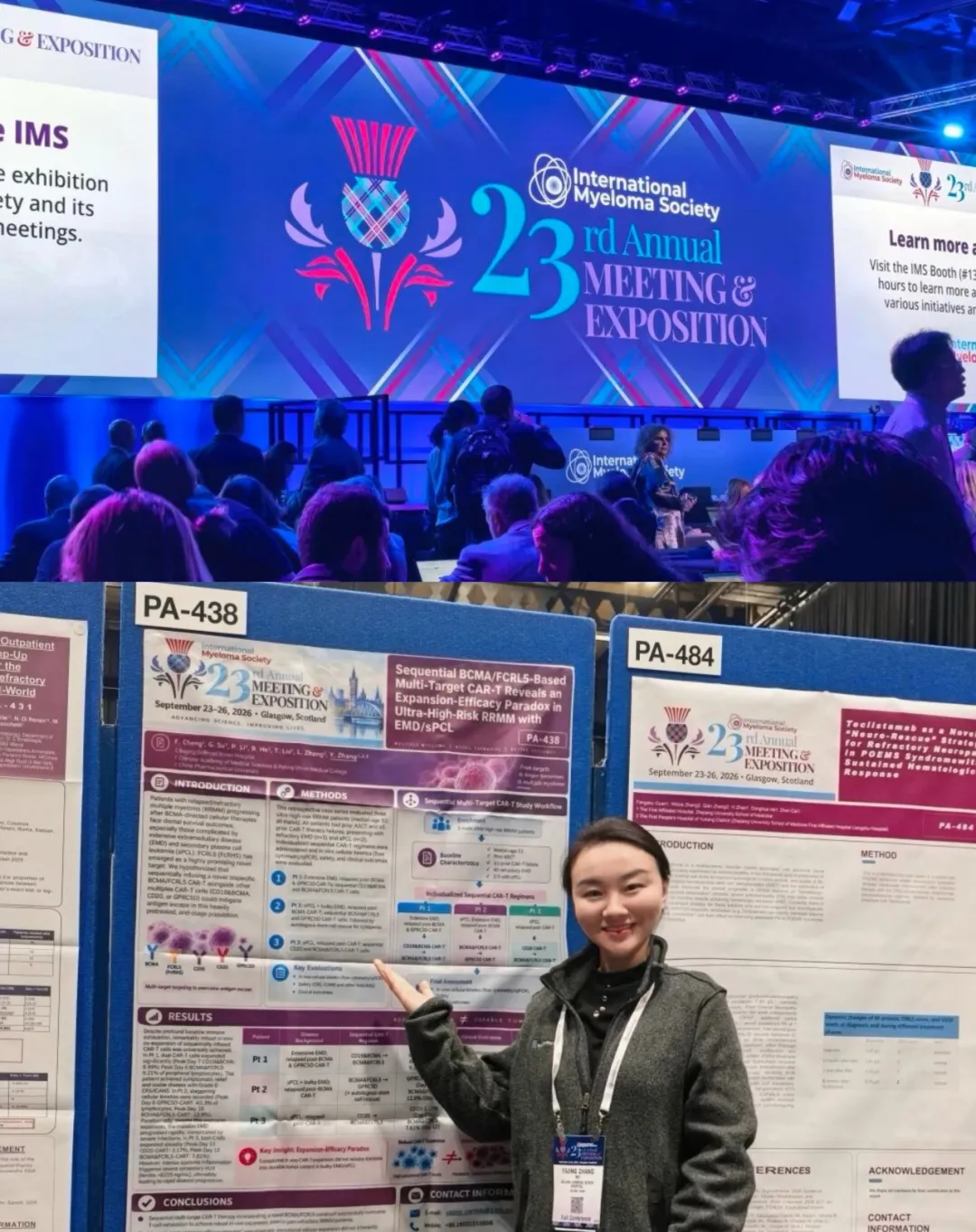
More than three decades ago, when scientists first tried to engineer T cells with the ability to recognize a specific target, the technology was aimed squarely at cancer. Today CAR-T is moving from hematologic malignancies into refractory autoimmune disease — and in doing so it offers a new research path for understanding and intervening in abnormal immune responses.
In November 2026, at the American College of Rheumatology annual meeting (ACR Convergence 2026), the team of Dr. Zhang Yajing at Beijing GOBROAD Boren Hospital and collaborating research groups had 6 studies accepted as posters, all focused on CAR-T for refractory autoimmune disease and covering dual-target immune intervention, organ-response assessment, and novel CAR-T technology platforms.
From clearing malignant B cells to exploring the remodeling of a dysregulated immune network, the boundaries of CAR-T research keep expanding. Dr. Zhang and her collaborators ask a further question: once the abnormal immune response is brought under control, is there still room for improvement in the function of tissues and organs that have already been damaged?
Behind these results sits another question, one closely tied to new drug development: can clinical investigators identify the key problems from real patient responses and feed them back into product development and clinical strategy? From executing protocols to taking part earlier in study design, patient stratification, and product optimization, the role of the research hospital is extending toward the front end of the innovation chain.
From Blood Cancers to Autoimmune Disease: CAR-T's Crossover Exploration
The arrival of CAR-T therapy once brought a new option to some patients with relapsed and refractory hematologic malignancies.
In the late 1980s the Israeli scientist Zelig Eshhar was among the first to attempt to install a chimeric receptor on T cells that could recognize a specific antigen. In 2011 the team led by Carl June reported breakthrough efficacy for CAR-T in advanced leukemia. In 2017 the world's first CAR-T therapy was approved, formally opening a new era of cellular immunotherapy.
Today, CAR-T research is expanding from blood cancers into autoimmune disease.
Dr. Zhang points out that hematologic malignancies and some autoimmune diseases share an important mechanistic intersection around B cells. CAR-T uses engineered T cells to recognize and clear cells expressing a specific target antigen; CD19 CAR-T mainly targets CD19-positive B cells. In B-cell malignancies the therapeutic intent is to eliminate tumor cells, whereas in some autoimmune diseases B cells contribute to pathogenesis through autoantibody production, antigen presentation, and cytokine networks. This mechanistic overlap provides the scientific rationale for CAR-T's crossover application.
In 2021 a team at the University of Erlangen in Germany was the first to report CD19 CAR-T in patients with refractory systemic lupus erythematosus. A 2022 study published in Nature Medicine showed that patients achieved clinical remission and remained in remission even after B cells reappeared. This suggests that deep B-cell depletion may reset an abnormal immune state in some patients, although the depth, durability, and eligible population of such immune resetting still require further study.
Along this line, exploration of CAR-T for autoimmune disease has moved from verifying clinical efficacy toward deeper mechanistic research and technology iteration.
"What we really need to do is not simply plug the leak or suppress the immune response, but cut off the source of the disease." Dr. Zhang compares autoimmune disease to a house that keeps leaking: the persistent abnormal immune response is the running tap, while damage to the skin, joints, and lungs is the soaked floor and furniture. Conventional treatment usually requires continuous control of inflammation and immune activity, whereas CAR-T may interrupt the abnormal immune cycle by deeply intervening in the pathogenic immune cell populations.
But once the tap is turned off, can the already soaked floor and furniture still be restored?
At ACR 2026 these 6 studies explore that question from different angles: 4 focus on CD19/BCMA dual-target CAR-T, observing early immune and clinical changes in patients with refractory systemic lupus erythematosus, systemic sclerosis, and overlap connective tissue disease; the other 2 explore novel technology platforms — non-viral gene delivery and in vivo generation of CAR-T.
Together the work examines deep intervention along the B-cell–plasma-cell axis, early changes in organs such as skin and lung after treatment, and technology routes that may be more manufacturable and more accessible. These remain largely early clinical evidence, and long-term efficacy and safety require continued follow-up.
"We found that after treatment, not only was the disease brought under control, it improved — organ function recovered to some degree." Looking back on the early exploration, Dr. Zhang recalls several clinical changes that warrant deeper study:
- In some patients with systemic sclerosis, skin hardening lessened and mobility improved after treatment, and in some cases improvement was also observed in lung function or imaging parameters;
- In some patients with refractory systemic lupus erythematosus, disease activity decreased after treatment, but responses across different organs were not fully consistent;
- In Sjögren's disease, working with a collaborating team, a case of non-viral transfected dual-target CAR-T was reported, with early signals of B-cell and plasma-cell lineage clearance observed; the patient has now been followed for six months, and clinical efficacy and durability of remission continue to show encouraging signals.
These observations provide a basis for further research and also suggest that treatment response may differ across diseases, across organs, across disease stages, and between individual patients.
From target-cell clearance to immune remodeling and then to changes in organ function, many important questions remain for clinical research to answer one by one in the field of CAR-T for autoimmune disease.
From Trial Executor to Co-Designer of Innovative Drug Development
Many breakthroughs in the history of pharmaceutical innovation have depended on sustained interaction between clinical questions, basic research, and industrial development.
From all-trans retinoic acid driving differentiation therapy in acute promyelocytic leukemia, to collaboration between clinical investigators and companies in the development of imatinib, to CAR-T's gradual journey from academic exploration to industrialization, clinical research has always been an essential part of innovation.
These examples point to the same fact: clinical findings are not only the final gate through which a drug's efficacy is verified, but may also be the starting point of a scientific question — and may even determine where an innovative technology ultimately goes.
As China's innovative drug industry moves toward differentiated research and global competition, a drug's competitiveness depends not only on the novelty of its target or technology, but on whether it can find the patients who will truly benefit, design a sound clinical development path, and prove clinical value with reliable evidence.
This also means that clinical investigators and research hospitals, positioned at the core of innovative drug development, are seeing their roles reshaped.
In Dr. Zhang's view, rigorous and standardized execution of clinical trials remains the foundation of research quality and patient safety. But in the early stage of innovative drug development, when the product mechanism, indication selection, and the population that will benefit are still being explored, clinical investigators can also take part earlier in framing the scientific question, designing the study, and optimizing the subsequent development strategy.
"From taking part in the design of innovative drug research at an early stage, through advancing the different phases of study, to eventual approval and marketing — that is the complete research chain," Dr. Zhang says.
In the field of cutting-edge cell therapy, this kind of reverse empowerment is especially critical. Take CAR-T for systemic lupus erythematosus: Dr. Zhang's team observed that in some patients disease activity fell after treatment, yet proteinuria did not improve in step. Further renal pathological assessment suggested irreversible tissue damage in some of these patients. The task then becomes distinguishing two things: the optimal window for intervening in ongoing immune-inflammatory activity, and the threshold beyond which structural damage that has already formed can no longer be reversed.
This observation offers important implications for subsequent study design: how should organ damage be assessed for activity versus established injury before enrollment? How should the appropriate timing of intervention and the target patient population be defined? How should endpoints be set that reflect both immunological change and organ benefit? And how can the patients most likely to gain the greatest clinical benefit be identified?
Dr. Zhang notes that early-phase clinical research must not only verify safety and efficacy, but also, through indication selection, patient stratification, and treatment optimization, find a differentiated development path for the product. This is precisely how clinical research delivers reverse empowerment to innovative drug development.
Yet to genuinely take on the role of co-designer, a research hospital also needs several key capabilities:
- First, investigators (PIs) with early-phase clinical research experience who understand disease mechanisms and product characteristics, and who can offer professional judgment on indication, risk, and endpoint design;
- Second, a standardized research system that runs through ethics review, clinical execution, sample testing, data evaluation, and project management;
- Third, interdisciplinary collaboration that allows experts in clinical medicine, immunology, pathology, and cell engineering to work together effectively.
Taking GOBROAD Medical Group's research practice as an example, collaboration between the clinical team and the testing and evaluation functions creates the conditions for continuous observation of treatment response and timely identification of scientific questions. Research efficiency and quality must ultimately be tested by disciplined project management, complete data, and reproducible results.
For biotech companies whose innovation capacity is still accumulating, this kind of platform value is especially pronounced. Being able to work in depth with a medical institution that has early-phase clinical research experience and multidisciplinary capability means a product has the chance to receive effective clinical feedback earlier, reducing misjudgments about clinical need and patient benefit during development.
"When the work of a clinical PI can help a new drug developer or sponsor, that is a virtuous cycle," Dr. Zhang believes. A research hospital should not only undertake mature registration trials, but also help early-stage innovative companies refine their study designs, identify genuine clinical value, and move products from proof of concept toward subsequent development.
From trial executor, to co-designer of early development, to driver of technology iteration and translation, the value of the research hospital continues to extend toward the front end of the innovation chain.
November 2026, Orlando. After the conversations at ACR are over, Dr. Zhang will return to treating disease, following up patients, and exploring early-phase clinical research. Compared with the frontier discussions in the session hall, the daily work is more concrete: assessing one patient's response, tracking one abnormal laboratory value, or re-examining a research hypothesis because of a single unexpected treatment response.
"On the road of early-phase clinical research there are no shortcuts. Every step has to be taken with reverence and great caution." Looking back on the journey of early cell therapy exploration, Dr. Zhang says this with feeling.
Start from unmet needs in the clinic, find the questions in research, test hypotheses, accumulate evidence, and then feed the findings back into new drug development. It is precisely in this continuous back-and-forth between clinic and laboratory that clinical PIs and research hospitals have the opportunity to create more solid and verifiable value for innovative drug development.
This article is a press summary of a conference interview and is intended for general informational purposes only. It does not constitute medical advice, diagnosis, or treatment. Please consult a qualified physician for any medical decision.