
Tumor-infiltrating lymphocyte, or TIL, therapy has moved in a few years from an experimental procedure performed in a handful of centres to a treatment that patients ask about by name. The idea behind it is unusual. Instead of engineering a new receptor into a patient's T cells, the therapy takes the lymphocytes that the immune system has already sent into the tumor — cells that have recognised something real — and gives them the numbers and the conditions to finish the job.
GoBroad Healthcare Group (GHG) International Medical Center now offers TIL-related specialist assessment and individualised care for three groups of solid tumors: melanoma, head and neck squamous cell carcinoma, and non-small cell lung cancer. The programme runs on a multidisciplinary team spanning the relevant oncology specialties, a standardised cell-therapy platform and an integrated cancer care system. It covers the whole pathway — clinical evaluation, tumor tissue procurement, TIL manufacturing, treatment delivery and long-term follow-up — and plans surgery, immunotherapy, targeted therapy and other modalities around the cell therapy rather than after it.
The brochure that the centre has issued for patients puts the proposition in one line: harnessing the immune system, expanding treatment options. What follows is what the treatment involves, what the 2026 data show, and how a patient outside China can be assessed.
What the Treatment Involves
TIL therapy begins with tissue. A lesion is removed surgically — a procedure that in some patients also has a therapeutic purpose if the tumor is causing symptoms or compressing something — and the specimen is taken to a laboratory, where the lymphocytes that had already infiltrated it are separated from the tumor cells. Those lymphocytes are then expanded in culture over several weeks until a dose measured in billions of cells is available.
Before the cells are returned, the patient receives a short course of lymphodepleting chemotherapy. Its purpose is not to treat the cancer but to empty the immunological space that the infused cells need in order to expand and persist; without it, the transferred lymphocytes compete with the patient's own cells and engraft poorly. The TIL product is then infused, and the patient is monitored closely in hospital during the period in which the cells expand and act.
Two consequences follow for patients considering the treatment. It takes time — weeks between the resection and the infusion, which is why it is offered to patients whose disease can wait that long. And it is demanding: the conditioning and the supportive care that follows require a centre that handles cell therapy routinely. The precise regimen, the cell dose and the supportive care are set by the treating team and, where a patient enters a study, by the protocol.
2026: Two Late-Breaking Abstracts
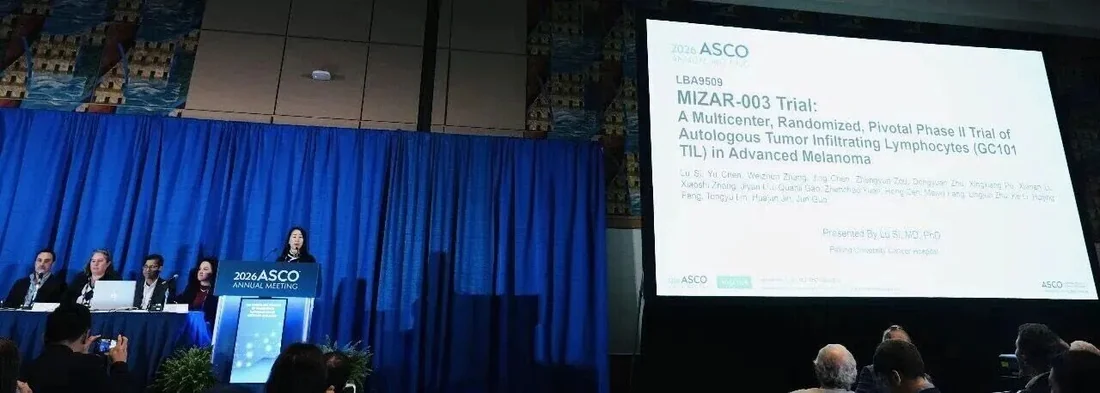
The clinical evidence behind the programme came into focus this year. The pivotal Phase II study of TIL therapy led by Prof. Jun Guo at Beijing GoBroad Hospital was selected for oral presentation at the 2026 annual meeting of the American Society of Clinical Oncology as a Late-Breaking Abstract, LBA9509 — described by the group as the first clinical study of TIL cell therapy for solid tumors to be presented in that category in ASCO's history.
On 23 October, Prof. Si Lu, from Prof. Guo's team, presented the extended follow-up results at the 2026 congress of the European Society for Medical Oncology in Madrid as Late-Breaking Abstract LBA55. That second presentation matters for a reason that is specific to cell therapy: the benefit of an infused living product can deepen or fade with time, so a follow-up cut taken months after the primary analysis is a stronger test of the treatment than the first look.
The Phase II Data
The study, MIZAR-003, randomized patients with advanced melanoma between GC101 — nolgileucel injection, the autologous TIL product — and the investigator's choice of chemotherapy. The comparison is against active treatment rather than placebo, which is the right design for a disease in which a control arm still has to be offered something, and it makes the size of the differences the point.
- Median progression-free survival was 4.37 months with GC101 against 1.61 months with chemotherapy.
- Objective response rate was 44.0 percent against 8.2 percent.
- Disease control rate was 64.0 percent against 38.8 percent.
Results were also reported by melanoma subtype, which is where the Chinese picture differs from the Western one. In mucosal melanoma, median progression-free survival was 4.81 months against 1.45 months; in acral melanoma, 4.37 months against 1.38 months. Both subtypes are far more common in Asian patients than in European or North American cohorts, and both are notoriously resistant to conventional immunotherapy — which is why a cell therapy that works in them addresses an unmet need rather than duplicating an existing option.
Beyond melanoma, a Phase I study of GC101 in advanced non-small cell lung cancer reported an objective response rate of 41.7 percent, with notable tumor shrinkage in some patients — an early signal in a tumor type for which TIL therapy had previously produced little.
Three Tumor Types, Three Different Problems
The centre concentrates on three groups of solid tumors, and the reason to separate them is that the clinical question in each is different.
- Melanoma. The tumor type with the longest history of TIL therapy, and the one in which the pivotal data above were generated. Within melanoma, mucosal and acral subtypes are the cases in which standard immunotherapy most often disappoints, and the ones for which Asian patients most often seek alternatives.
- Head and neck squamous cell carcinoma. A tumor that is accessible for tissue procurement, recurrent in a substantial share of patients after surgery, radiotherapy and platinum-based treatment, and immunologically active enough that TIL therapy is a rational line of investigation.
- Non-small cell lung cancer. The largest of the three populations, and the hardest, because the tumor is often diagnosed at a stage when tissue for manufacturing is limited. The Phase I signal is what makes the assessment worth having.
The Care Journey
The centre describes four stages, and it is worth knowing what each one asks of the patient.
- Specialist assessment. The record is reviewed by the relevant oncology specialists: pathology, imaging, molecular results, and every prior line of treatment with its dates and outcomes. The output is a judgement about whether the patient is a candidate for TIL therapy, for a related clinical study, or for neither.
- Cell manufacturing. If the patient proceeds, tumor tissue is obtained and the lymphocytes are expanded in the laboratory. This is the stage that cannot be compressed, and the one that depends on having enough viable tissue.
- Treatment delivery. Lymphodepletion, infusion and the inpatient monitoring that follows, delivered by a team that does this routinely and can manage the complications that cell therapy can produce.
- Long-term follow-up. Response assessment, surveillance for relapse and management of late effects, coordinated with the patient's own physicians at home wherever that is possible.
For a first assessment, the documents that matter most are the pathology report, the most recent imaging, the molecular profiling report where one exists, and a treatment history that states what was given, when, and what happened. Patients who arrive with those four items in hand move through the assessment considerably faster than those who do not.
Why the Centre Argues for Itself
The brochure makes four claims, and they are worth restating because they describe how the programme is built rather than what it promises.
- A multidisciplinary team. Joint assessment across the relevant specialties, with an individualised plan as the output rather than a single clinician's opinion.
- Clinical research access. Assessment of TIL-related studies and innovative treatment opportunities, which for a therapy still in late-stage development is often the difference between access and no access.
- Personalised comprehensive care. Sequencing of TIL therapy with surgery, immunotherapy, targeted therapy and other options, so that the cell therapy takes its place in a plan rather than replacing one.
- Care coordination. Continuous support from assessment through treatment and follow-up, which for an international patient includes the logistics of a stay measured in weeks.
The centre is explicit about the limit of all this: treatment availability, research status and eligibility are subject to specialist assessment, and the availability of a particular option for a particular tumor type changes as studies open and close.
Who May Seek Assessment
The population the centre invites is specific: patients whose disease has progressed or recurred after standard treatment and who want to explore further options. That framing matters, because TIL therapy is not a first-line treatment and not a substitute for standard care. It is a later line for patients who have already used the established ones.
In practice, a patient with advanced melanoma — including mucosal and acral subtypes — recurrent head and neck squamous cell carcinoma, or non-small cell lung cancer that has progressed on standard therapy is the person for whom an assessment is worth arranging, provided there is tissue that can be obtained and the disease is not advancing so quickly that the manufacturing interval cannot be bridged.
The Team
Two specialists lead the clinical side of the programme.

Prof. Jun Guo is Academic Lead of Melanoma and Sarcoma Oncology and of Genitourinary Oncology at Beijing GoBroad Hospital, and Vice President of the Melanoma World Society. He led the pivotal Phase II TIL therapy trial whose findings were selected as Late-Breaking Abstracts at both ASCO and ESMO 2026, and he has spent his career on the tumor type in which immunotherapy first worked — and on the subtypes in which it too often does not.

Prof. Haifeng Qin is Director of the Department of Thoracic Oncology and Tumor Immunotherapy at Beijing GoBroad Hospital, with more than 30 years of experience in comprehensive solid tumor care. He led China's first clinical study of TIL cell therapy, and his department is where the thoracic and immunotherapy sides of the programme meet.
How to Reach the Programme
Patients and families outside China can approach the programme through the MedTourChina central line below. The referral team collects the pathology report, imaging, molecular results and treatment history, has them reviewed by the centre's specialists, and reports back on whether an assessment visit is worth arranging — before any commitment to travel is made.
Enquiries are handled in English. Where a patient is likely to be assessed for a clinical study rather than for commercially available treatment, the team says so at the outset, because the eligibility criteria and the timetable are different.
References
- Lu S, Guo J, et al. MIZAR-003: a multicentre, randomised, pivotal phase II trial of autologous tumor-infiltrating lymphocytes (GC101) in advanced melanoma — extended follow-up. Annals of Oncology. 2026 (ESMO Congress, Late-Breaking Abstract LBA55).
- Guo J, Lu S, et al. MIZAR-003: a multicentre, randomised, pivotal phase II trial of autologous tumor-infiltrating lymphocytes (GC101) in advanced melanoma. Journal of Clinical Oncology. 2026 (ASCO Annual Meeting, Late-Breaking Abstract LBA9509).
- Phase I study of GC101, an autologous tumor-infiltrating lymphocyte therapy, in advanced non-small cell lung cancer. ESMO Immuno-Oncology Congress. 2025; Abstract 80P.
- MIZAR-003: autologous tumor-infiltrating lymphocytes in advanced melanoma. ClinicalTrials.gov identifier NCT06703398.
This article is a press summary based on the patient brochure on TIL therapy published by GoBroad Healthcare Group International Medical Center in November 2026, together with the congress abstracts it cites. Treatment availability, eligibility and the status of any clinical study change over time, and the figures quoted here come from the study populations described rather than from any individual patient. It is intended for general informational purposes only and does not constitute medical advice, diagnosis, or treatment. Please consult a qualified physician for any medical decision.