A Broader Toolbox, a Harder Decision
With CAR-T cell therapy, bispecific antibodies and an expanding set of targeted agents, patients with relapsed or refractory lymphoma now have more treatment options than at any point in the past. Yet for patients who relapse or continue to progress after multiple lines of therapy, three questions remain difficult: whether a further remission is achievable at all, which mechanism to try next, and how to convert a response into durable disease control.
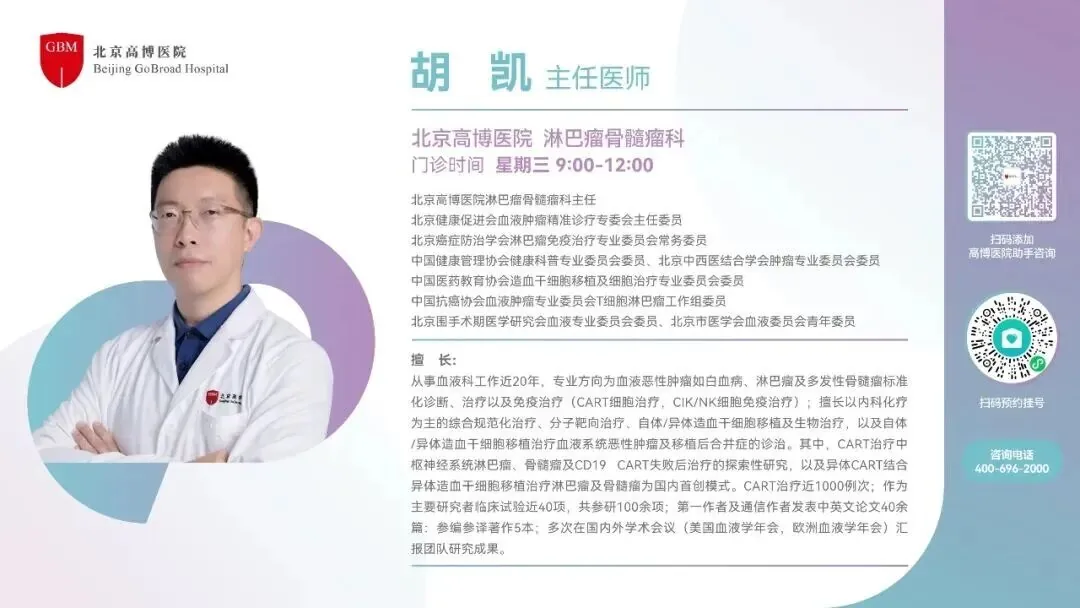
Dr. Hu Kai, Director of the Lymphoma and Myeloma Department at Beijing GOBROAD Hospital, addressed these questions in a specialist broadcast jointly organised by Global Oncology, No-Cancer Home, Snow White Happy Island and GOBROAD Medical Group, covering treatment strategy in relapsed and refractory disease, central nervous system lymphoma, relapse after CAR-T therapy, and the design of individualised long-term management.
Relapsed Disease Is Not One Disease
Question: Do patients with relapsed or refractory lymphoma still have a chance of achieving remission again?
Dr. Hu Kai: Relapsed and refractory lymphoma is highly heterogeneous. Even with an identical pathological diagnosis, responses can differ markedly between patients, and the options available at relapse depend on the regimens already received, the number of prior lines, how long the previous remission lasted, and the tumour burden, physical condition and immune status at the time of relapse.
Consider two contrasting patterns. One patient achieved a long first remission, relapsed a year or two later, was detected early with a low tumour burden and had received relatively limited prior therapy; that patient may still have favourable conditions for further treatment. Another patient responded initially but relapsed quickly, with rapid progression and a high tumour burden at relapse; treatment is considerably harder despite the earlier response. This is precisely why scheduled surveillance matters, especially in the first years after an initial remission, when early detection of a change buys better conditions for the next line of therapy.
For patients who have not responded to multiple lines of chemotherapy, or whose disease keeps progressing, the prior strategy itself needs to be re-examined. Once clear chemoresistance is established, repeating the same class of treatment or simply escalating chemotherapy intensity is unlikely to add benefit. That is the point to evaluate a change of mechanism, such as CAR-T cell therapy or a bispecific antibody, in order to overcome the resistance that has already developed.
The practical rule is therefore twofold: standardise the first-line approach, and individualise the relapsed setting. A patient should never be judged by the label "relapsed and refractory" alone.
Central Nervous System Lymphoma: Three Advances on a Chemotherapy Foundation
Question: What makes central nervous system lymphoma difficult, and what recent progress deserves attention?
Dr. Hu Kai: Lymphoma is usually treated systemically, but central nervous system disease has to cross the blood-brain barrier, and many drugs cannot reach therapeutic concentrations inside the central nervous system. The result is a narrow set of options. High-dose methotrexate, for example, requires hydration, leucovorin rescue and therapeutic drug monitoring, and some patients develop renal impairment; completing a full-dose course is difficult in older or frail patients, while insufficient intensity and subsequent resistance make disease control harder still.
Three developments are worth watching. Small-molecule targeted agents, notably BTK inhibitors, have shown useful activity in a subset of patients. CAR-T cell therapy has been shown to enter the central nervous system and to produce responses in some relapsed and refractory patients, currently delivered by intravenous infusion. Bispecific antibodies have also demonstrated antitumour activity in clinical practice.
None of this displaces standard chemotherapy, which remains the backbone of treatment. In current practice, patients who are chemotherapy-sensitive, achieve a remission and are transplant-eligible should still be considered for autologous haematopoietic stem cell transplantation as consolidation. Whether adding a BTK inhibitor to first-line treatment improves long-term outcomes still requires randomised evidence.
Secondary central nervous system lymphoma is more complex again, because these patients usually have a treatment history and the plan has to cover both central and systemic disease. When a remission is achieved, the opportunity for consolidation should be assessed immediately: the window is short, and focusing only on the immediate disease control risks losing the chance to prevent the next relapse.
After CAR-T Failure: Diagnose the Reason Before Choosing the Next Drug
Question: For patients who relapse after CAR-T therapy, what options remain?
Dr. Hu Kai: CAR-T cell therapy has created genuine new opportunities, but not every patient achieves a durable remission, and relapse after CAR-T has become a routine clinical problem. The essential first step is to establish why the treatment failed. Did the CAR-T cells fail to expand adequately? Has the target, such as CD19, been lost or altered? What was the patient's immune status at the time? Did the disease progress immediately after infusion, or after a period of response?
Different mechanisms lead to entirely different plans. If CD19 is still expressed at relapse, some patients can be considered for another CD19-directed approach or a second CAR-T infusion after full assessment. If CD19 has been lost, a different target or mechanism is required.
Bispecific antibodies are a reasonable option, although their activity relates to the prior CAR-T response and to immune cell function. In our experience, patients who responded clearly to CAR-T and maintained that response for a relatively long period may still benefit from a bispecific antibody; where CAR-T never worked and progression followed quickly, the decision should be made far more cautiously.
Conventional chemotherapy should not be written off either. Some patients move to CAR-T or a bispecific antibody after relatively limited chemotherapy, relapse later, and on re-analysis of prior exposure and chemosensitivity may still have an effective regimen available, allowing a further remission and subsequent assessment for consolidation such as transplantation.
Relapse after CAR-T therefore does not mean the end of treatment options. It means the reasons for the previous failure have to be identified and a different, better-supported direction chosen.
Individualised Treatment Requires a Plan for the Whole Course
Question: With so many options available, how should an individualised plan be built for a relapsed or refractory patient?
Dr. Hu Kai: The decision involves many variables, and the patient's disease state changes with each treatment, so no single fixed regimen solves every case.
The first step is to judge whether chemoresistance has been established and whether the patient needs to move from conventional chemotherapy to immunotherapy or another mechanism. The second is to assess fitness and tolerance. A tumour may look as though it requires intensive treatment, yet age, immune function, infection risk or organ function may not allow that intensity to be delivered. The question is not only which regimen is more active, but whether the patient can receive it safely and completely.
The third, and easily overlooked, element is an overall plan. For a relapsed patient the goal has to be defined in advance: is the immediate aim to reduce tumour burden, or to create the conditions for CAR-T therapy or stem cell transplantation? If a remission is achieved, how will it be consolidated?
With the direction set, the sequence and timing of treatments have to be arranged deliberately. For a patient who may later receive CAR-T, earlier regimens must be chosen with T-cell collection and CAR-T manufacturing in mind, so that a short-term gain does not close off a later option. Timing matters as much as sequence: the conditions that make a treatment feasible today may change as the disease evolves, so the plan has to be adjusted according to the actual result of each line.
Practical factors also shape what is achievable, including the patient's financial situation and family support. Physicians need to discuss the trade-offs between benefit, safety and real-world constraints openly. And a remission is not the end of treatment: consolidation or maintenance, scheduled surveillance and rehabilitation are all part of the pathway, with the aim of returning the patient to a stable life and functional level under shared long-term management.
A Department Built Around Relapsed and Refractory Disease
Question: What does the Lymphoma and Myeloma Department at Beijing GOBROAD Hospital offer patients with relapsed or refractory disease?
Dr. Hu Kai: The team has long-standing clinical experience in this field and has focused on relapsed and refractory lymphoma and myeloma since the department was established. It has now treated approximately 2000 patients in this category. That concentration of complex cases has deepened the team's understanding of how different diseases behave, why previous treatments fail, and what new agents and new therapies can realistically deliver in terms of efficacy and safety.
The department has built a complete treatment system spanning chemotherapy, targeted therapy, CAR-T cell therapy, clinical research on investigational agents, and both autologous and allogeneic haematopoietic stem cell transplantation. For patients whose disease is complex and who need several modalities in sequence, the team can construct a continuous plan and adjust strategy at each stage.
In CAR-T therapy specifically, the team began clinical research in relapsed and refractory lymphoma and myeloma early, has participated in trials of several approved CAR-T products, and has accumulated experience in timing, response assessment, toxicity management and the handling of post-CAR-T relapse. More than 80 related results have been presented as oral or poster presentations at international academic meetings.
The hospital also provides supporting services covering investigational drugs, inpatient management, and the interface between public and commercial insurance settlement, which helps reduce the practical difficulties patients encounter during treatment. The aim is straightforward: use accumulated experience and a complete treatment system to find the most suitable direction for each patient, capture the treatment opportunity while it exists, and secure the best possible long-term outcome.
Learn More or Contact Us
If you would like to know more about the diagnostic pathways, treatment options or clinical studies described in this article, our international patient team can help you understand what is available at GOBROAD hospitals. Your personal information is protected in accordance with applicable regulations.