From HLA Matching to Gene-Guided Donor Selection
Allogeneic hematopoietic stem cell transplantation (allo-HSCT) is a potentially curative treatment for relapsed or refractory hematologic malignancies. For decades, human leukocyte antigen (HLA) matching has been the cornerstone of donor selection. However, mounting evidence shows that germline genetic background also plays a decisive role in transplant success.
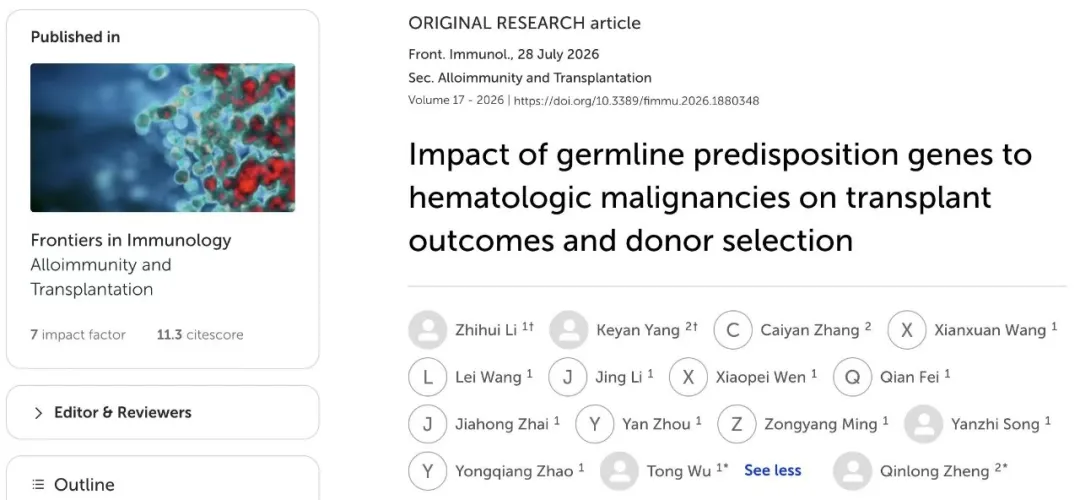
Recently, the expert team at Beijing GOBROAD Boren Hospital published a large-scale retrospective study titled Impact of germline predisposition genes to hematologic malignancies on transplant outcomes and donor selection in the international immunology journal Frontiers in Immunology (Impact Factor 7.0). The study systematically evaluated how germline predisposition gene mutations affect transplant prognosis in patients with hematologic malignancies.
Professor Wu Tong and Professor Zheng Qinlong are the co-corresponding authors; Dr. Li Zhihui and Dr. Yang Keyan are the co-first authors. The findings provide important evidence-based guidance for moving donor selection from HLA matching alone toward integrated gene-based decision-making.
Background: Germline Predisposition Is Reshaping Transplant Decisions
With the widespread use of genomic sequencing in clinical hematology, germline predisposition variants are increasingly identified in patients with hematologic malignancies and their family members. Since 2016, the World Health Organization has classified myeloid neoplasms with germline predisposition as a distinct disease category. Importantly, this predisposition is not limited to myeloid malignancies; it also involves lymphomas and plasma cell neoplasms.
Although allo-HSCT outcomes are influenced by disease characteristics, patient condition, and donor factors, two major gaps remained in prior research: the absence of large real-world cohorts systematically mapping germline predisposition mutations across pediatric and adult transplant recipients, and the lack of uniform clinical criteria for how these mutations should inform donor selection.
To address these gaps, the Beijing GOBROAD Boren Hospital team conducted a single-center retrospective study of 558 consecutive transplant patients, covering the full spectrum of hematologic diseases including acute lymphoblastic leukemia (ALL), myeloid neoplasms, lymphoma, and myelodysplastic syndrome (MDS). The cohort included children, adults, second transplant recipients, and patients at high risk of relapse, faithfully reflecting the genomic features of a high-risk Chinese transplant population and their associations with prognosis.
Study Methods
The study retrospectively enrolled 558 patients who underwent HSCT at Beijing GOBROAD Boren Hospital between December 2017 and February 2024. Of these, 557 received allogeneic HSCT and one received autologous HSCT. The median age was 16.14 years; 298 were children under 18 and 260 were adults. The main disease types were B-ALL (40.3%), acute myeloid leukemia (AML, 28.1%), and T-ALL (6.6%). Regarding donor type, 70.1% received haploidentical related-donor transplants and 22.4% received unrelated-donor transplants.
Before transplantation, peripheral blood mononuclear cells were collected from all patients for targeted next-generation sequencing of more than 900 genes. Candidate variants were further validated by Sanger sequencing of non-hematopoietic tissues such as oral mucosa or fingernail samples to confirm their germline origin rather than somatic mutation. Variant classification followed ACMG and HGMD guidelines; only pathogenic and likely pathogenic variants were included. Inborn errors of immunity (IEI) mutations were classified according to the 2022 human inborn errors of immunity classification. Follow-up continued through June 30, 2024, with a median follow-up of 33.8 months.
Key Findings
Finding 1: Disease-Specific Enrichment of Germline Mutation Profiles
The study found a median of three germline predisposition gene mutations per patient. The most frequently mutated genes were BTLA, TNFAIP3, MPEG1, EP300, MLH1, NCF2, MUTYH, KIT, STK11, and RET. Mutation profiles differed significantly between children and adults: children showed high-frequency mutations in KIT, CARD14, PROC, and TLR1, while adults showed high-frequency mutations in ASXL1.
Certain germline predisposition gene mutations were significantly enriched in specific disease types. HAVCR2 and STK11 mutations were enriched in B-cell non-Hodgkin lymphoma (B-NHL); IRF7 mutations were enriched in B-ALL/lymphoblastic lymphoma; UNC13D mutations were enriched in MDS; and TNFRSF13C mutations were enriched in chronic myeloid leukemia (CML). Notably, B-NHL patients carrying HAVCR2 mutations had significantly worse disease-free survival (DFS), and MDS patients carrying UNC13D mutations showed adverse trends in both DFS and overall survival (OS).
Finding 2: Unrelated Donors Nearly Double Survival in Homozygous Mutation Carriers
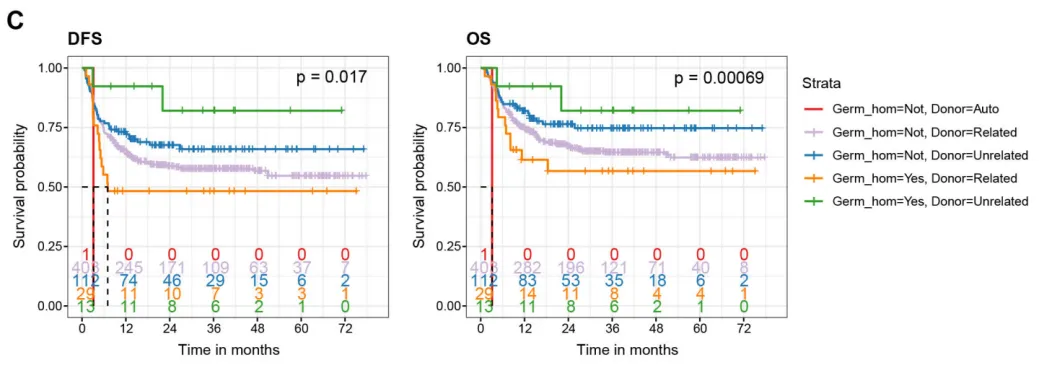
Among the 558 patients, 42 (7.5%) carried homozygous germline predisposition gene mutations. Univariate analysis showed that homozygous mutations themselves did not directly reduce transplant survival; instead, donor type was the critical determinant of prognosis.
In the homozygous subgroup, patients who received unrelated-donor transplants achieved 3-year DFS and OS of 82.1%, whereas patients who received related-donor transplants achieved only 3-year DFS of 48.3% and 3-year OS of 56.7% (DFS p=0.017, OS p=0.00069).
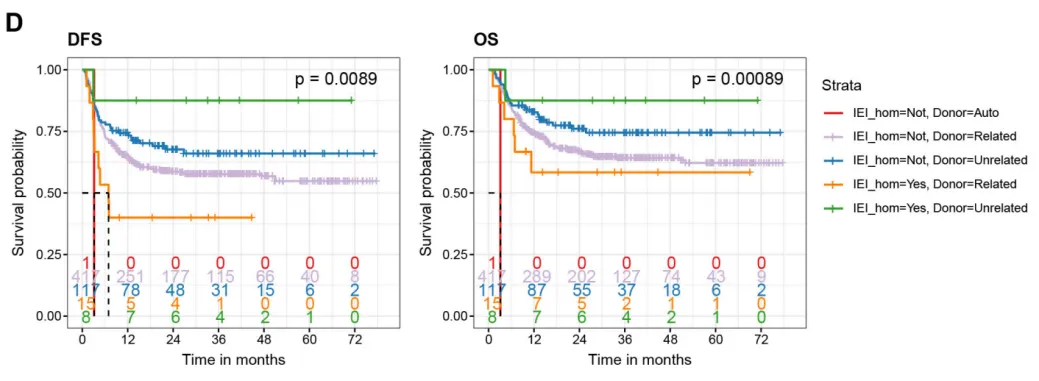
Among 23 patients with homozygous IEI mutations, the same trend was observed. The unrelated-donor group achieved 3-year DFS of 87.5% (95% CI: 67.3-100%) and 3-year OS of 87.5% (95% CI: 67.3-100%), while the related-donor group achieved only 40% DFS (95% CI: 21.5-74.3%) and 58.3% OS (95% CI: 37.4-90.9%) (DFS p=0.0089, OS p=0.00089).
Finding 3: IACHI Mutations Are an Independent Adverse Prognostic Factor
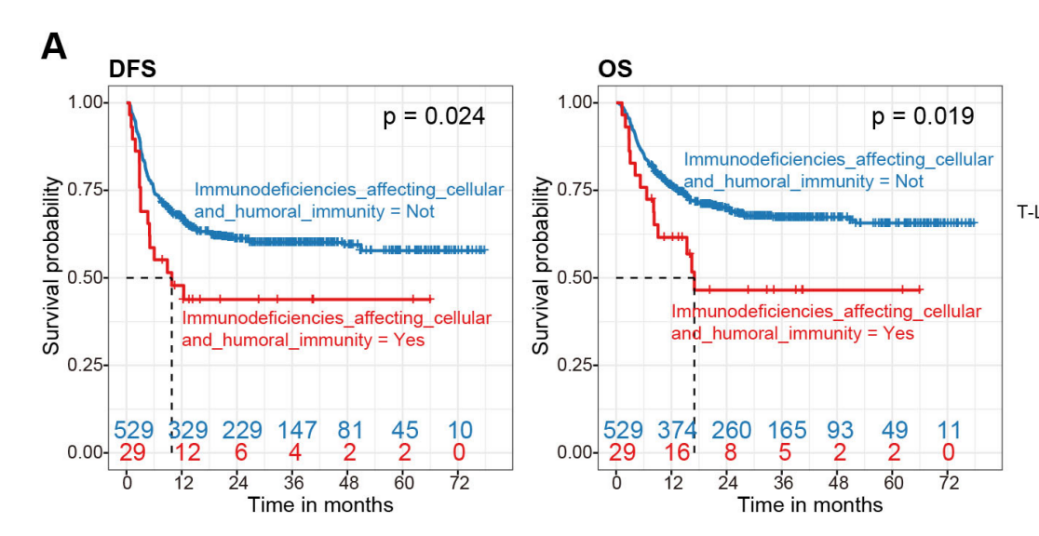
The study further subdivided IEI mutations and focused on the subgroup of immunodeficiencies affecting cellular and humoral immunity (IACHI). Among 29 patients carrying IACHI germline mutations, median DFS was only 9.83 months and median OS was only 17.0 months. Multivariate Cox regression confirmed that IACHI mutation is an independent adverse prognostic factor for overall survival (HR=1.843, p=0.0307).
These patients also had a significantly higher rate of post-transplant fungal infection than the general cohort (34.5% versus 18.0%, p=0.049). Further analysis showed that donor genotype significantly influenced prognosis: patients who received transplants from related donors carrying the same IACHI germline mutation had poor outcomes, with deaths mostly attributable to infection, multi-organ failure, or relapse; patients who received transplants from related donors without the mutation or from unrelated donors had significantly improved survival.
Multivariate Prognostic Model: Three Independent Predictors
The team constructed a comprehensive transplant prognostic risk model and identified three categories of independent predictors. Chronic graft-versus-host disease (GVHD) was the only independent protective factor, significantly reducing relapse and all-cause mortality. Adult patients had significantly higher overall mortality risk than pediatric patients. IACHI germline mutations independently increased post-transplant mortality.
It is worth noting that 17 TP53 variants initially detected by screening were subsequently validated as somatic mutations using non-hematopoietic tissue samples such as fingernails and oral mucosa. This highlights the clinical necessity of dual-sample testing to distinguish germline from somatic mutations and avoid misclassification of genetic risk.
Clinical Significance: From HLA Matching to Gene-Guided Matching
Traditional HSCT donor selection has relied primarily on HLA matching. This study suggests that germline predisposition gene screening should become an important complementary dimension. For patients carrying homozygous germline predisposition gene mutations, especially homozygous IEI-related mutations, prioritizing unrelated donors can significantly improve prognosis. For patients carrying IACHI mutations who are candidates for related-donor transplantation, donors should be screened for the same mutation before proceeding.
The authors note that 94.4% of patients in this cohort carried pathogenic or likely pathogenic germline variants, far higher than the 5% to 10% reported in general hematologic malignancy populations. This high prevalence is closely related to the high-risk characteristics of the cohort: 59.9% of patients had experienced relapse before the index transplant, and 24.4% were undergoing second transplantation. Therefore, the results should not be directly extrapolated to the general hematologic malignancy population, but they strongly underscore the clinical value of germline predisposition gene screening in high-risk transplant groups.
Conclusion and Future Directions
As a single-center retrospective study, this work has inherent limitations including selection bias, limited sequencing panel coverage, small subgroup sizes, and lack of multiple-testing correction. The research team plans to conduct prospective, multicenter studies in larger, disease-specific cohorts to further validate the role of germline predisposition genes in predicting transplant prognosis and optimizing donor selection.
Overall, the study systematically mapped the landscape of germline predisposition gene mutations in patients with hematologic malignancies undergoing HSCT and, for the first time, clearly demonstrated that homozygous germline predisposition gene mutations do not inevitably reduce survival; donor type significantly influences prognosis, and unrelated donors can nearly double survival benefit in these patients. The independent adverse prognostic effect of IACHI mutations and their implications for donor selection provide important new perspectives for clinical practice.
Germline predisposition gene mutations are important determinants of HSCT outcomes. For high-risk mutation carriers, rational donor selection can improve prognosis. These findings further emphasize the potential value of germline predisposition gene screening in guiding individualized donor selection for HSCT.
Reference
Li Z, Yang K, Zhang C, et al. Impact of germline predisposition genes to hematologic malignancies on transplant outcomes and donor selection. Front Immunol. 2026;17:1880348. doi:10.3389/fimmu.2026.1880348
Featured Experts
Professor Wu Tong
Director, Department of Hematopoietic Stem Cell Transplantation, Beijing GOBROAD Boren Hospital; Medical President
Professor Wu Tong has been engaged in hematopoietic stem cell transplantation for nearly 40 years and is an internationally renowned transplant expert. He has performed thousands of transplants and has extensive experience in selecting transplant modalities, managing severe GVHD and infections, treating refractory or relapsed leukemia with transplantation, preventing post-transplant relapse, post-transplant immunotherapy, transplantation in elderly patients, CAR-T sequential transplantation, and second transplantation. He has established a comprehensive transplantation system that achieves low transplant-related toxicity and high disease-free survival for both malignant and benign blood diseases.
Professor Zheng Qinlong
Director, Molecular Diagnostic Laboratory, GOBROAD Diagnostic Center; Member, Integrated Diagnostic Expert Panel
Professor Zheng Qinlong holds a medical degree from Shanghai Medical University and completed postdoctoral training at the University of Oklahoma Health Sciences Center. He has more than 30 years of laboratory testing and research experience in cancer and other diseases, including risk assessment, early diagnosis, prognosis evaluation, drug screening, and efficacy monitoring. He previously worked at the University of Oklahoma Health Sciences Center, UCLA Department of Clinical Pathology and Laboratory Medicine, the U.S. National Cancer Institute (NCI), and leading diagnostic centers in Beijing.
Dr. Li Zhihui
Director, Ward 3, Department of Hematopoietic Stem Cell Transplantation, Beijing GOBROAD Boren Hospital
Dr. Li Zhihui is a chief physician with a medical doctorate, a visiting scholar at Mayo Clinic, and a Taiping Young Scholar of the Hong Kong Institute of Technology. She serves as deputy director of the Hematology Digital Diagnosis and Treatment Committee of the Beijing Imaging Technology Alliance and has published multiple SCI articles in journals such as Blood Advances, Transplantation and Cellular Therapy, Bone Marrow Transplant, and Frontiers in Immunology. She has delivered oral and poster presentations at international hematology conferences including ASH, EHA, EBMT, and APBMT more than 30 times.
Dr. Yang Keyan
Molecular Diagnostic Laboratory, GOBROAD Diagnostic Center; Beijing GOBROAD Boren Hospital
Dr. Yang Keyan has worked in precision oncology for 8 years, focusing on pan-solid tumor and hematologic malignancy research, real-world data mining, and biomarker discovery. He has published more than 10 academic papers in domestic and international journals with a cumulative impact factor exceeding 80. His research has been selected for presentation at the European Hematology Association (EHA) and American Society of Hematology (ASH) annual meetings, with more than 30 cumulative conference abstracts.
Request a Transplant Consultation
If you or a family member is considering hematopoietic stem cell transplantation, our transplant team can provide individualized evaluation, donor selection guidance, and second-opinion services.
Book Consultation International Patient Services