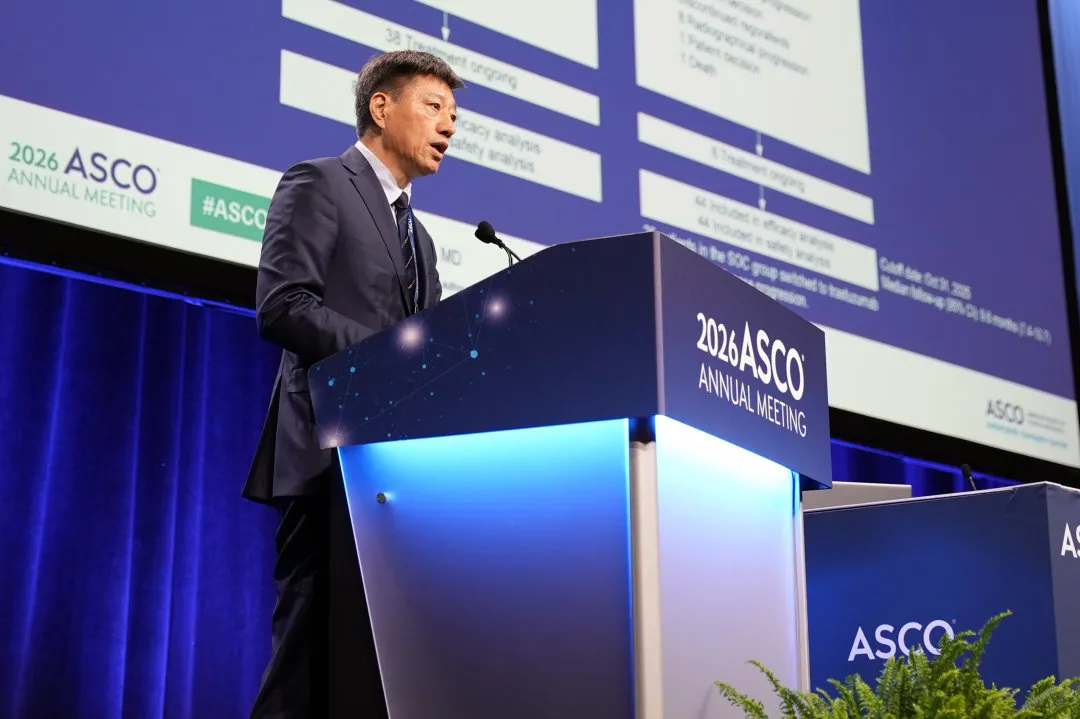
As precision oncology advances, evidence for HER2-targeted treatment continues to accumulate and its scope has expanded from gastric and breast cancer to colorectal, biliary tract and other solid tumours. Based on the DESTINY-PanTumor03 study, the HER2-targeted antibody-drug conjugate trastuzumab deruxtecan was approved on 20 October 2026 for adults with unresectable or metastatic HER2 IHC 3+ solid tumours who have received prior therapy or have no satisfactory alternative treatment option.
For patients with advanced cancer, every additional treatment option means another chance of survival benefit. At the same time, how to build further HER2-directed treatment exploration has become an important question in clinical practice. Trastuzumab deruxtecan is currently the first and only HER2-targeted ADC approved in gastric, colorectal and biliary tract cancer simultaneously. Prof. Li Jin, President of Shanghai GOBROAD Cancer Hospital affiliated to China Pharmaceutical University, was invited to share his thinking on HER2 testing, the pan-tumour exploration of trastuzumab deruxtecan and future clinical research directions, drawing on clinical practice in gastrointestinal oncology and the development of precision treatment.
Question 1: How Standardised Is Molecular Testing in Colorectal and Biliary Tract Cancer?
With targeted therapies for solid tumours multiplying, molecular testing has become an important prerequisite for identifying patients likely to benefit. In the era of molecular-targeted therapy, precision treatment rests on precision diagnosis: treatment aimed at a specific molecular target first requires testing to determine the patient's molecular subtype. Targets such as KRAS, BRAF, HER2, CLDN18.2 and FGFR all require standardised biomarker testing to identify likely responders. In current Chinese practice, molecular testing still needs further standardisation. For CLDN18.2, the growing use of targeted therapy in gastric cancer has highlighted the importance of testing, yet some hospitals still do not perform it routinely, and awareness of CLDN18.2 as a treatment target needs to be strengthened.
After years of standardisation, HER2 testing in gastric and breast cancer has essentially established clinical consensus and standards. In other tumours, however, because approved indications were previously scarce, views on the necessity of testing are not fully consistent. In biliary tract, colorectal and gynaecologic tumours, there is still no unified standard for which criteria to use or whether to test routinely. As anti-HER2 therapies continue to develop, the importance of HER2 testing deserves particular attention. Anti-angiogenic drugs such as anti-VEGF agents do not require biomarker-based patient selection, so their testing strategies differ. HER2 is different: trastuzumab, trastuzumab deruxtecan and potentially future anti-HER2 CAR-T cell therapies all depend on HER2 testing. Testing coverage should therefore be increased for patients with tumours that may carry HER2 abnormalities.
In future, as drug indications evolve, corresponding target testing should be progressively built into standardised diagnostic and treatment pathways. CSCO guidelines already identify required treatment targets in several tumour types. The next step is stronger promotion and education so that hospitals at the primary level fully recognise the value of molecular testing for precision treatment, allowing more patients to gain access to precision therapy through proper testing.
Question 2: Clinical Value Across HER2-Expressing Solid Tumours
I greatly appreciate the continued exploration of trastuzumab deruxtecan across tumour types, including colorectal, biliary tract and gynaecologic cancers. Cancer treatment is increasingly moving from traditional tumour-type classification towards target-driven therapy. The traditional Chinese medicine idea of treating the same disease differently and different diseases similarly has some relevance in the precision era. Trastuzumab deruxtecan has demonstrated efficacy in HER2-overexpressing breast and gastric cancer, and ongoing studies in colorectal and biliary tract cancer reflect precisely this concept.
The DESTINY-CRC02 study showed a median overall survival of 18.6 months with trastuzumab deruxtecan at 5.4 mg/kg in patients with centrally confirmed HER2 IHC 3+ colorectal cancer. DESTINY-PanTumor03 extended this exploration to a pan-tumour setting: in patients with HER2-positive solid tumours after failure of first-line therapy, the objective response rate in those with HER2 IHC 3+ tumours reached 58%, median progression-free survival was 15.7 months and median overall survival has not been reached.
For patients with advanced cancer, longer survival means not only more time, but more opportunities for subsequent treatment and clinical trial participation. As options expand, patients may receive first-, second-, third-line and later therapies, with each advance creating another chance of benefit. If patients with advanced cancer can eventually survive five, ten or even more years, that will be an important marker of progress. The goal of cancer treatment is not necessarily complete disappearance of the tumour: long-term disease control and living with stable disease also have important clinical value. For patients with advanced cancer, if you do not give up this second, there is hope the next. Extending survival and creating more treatment opportunities are precisely why continuous clinical research matters. Trastuzumab deruxtecan and the DESTINY-PanTumor programme are good news for patients with HER2-positive tumours.
Question 3: Future Breakthroughs and Cooperation Between Academia and Industry
Trastuzumab deruxtecan still has considerable room for exploration. Multidisciplinary collaboration and combination therapy are important directions in oncology. With median overall survival of 18.6 months in HER2 IHC 3+ colorectal cancer in DESTINY-CRC02, future DESTINY-PanTumor studies can further explore combinations with immunotherapy, other targeted agents and chemotherapy. Because trastuzumab deruxtecan carries a cytotoxic payload itself, combinations with chemotherapeutic drugs of different mechanisms deserve study. If a combination avoids substantial overlapping toxicity while further prolonging survival, it is worth pursuing.
Approval and use in the Asia-Pacific region create more opportunities for clinical research and practice. Besides company-sponsored trials, investigator-initiated trials after approval can also play an important role. Research funds can support clinicians in studying questions that arise in daily practice. Real-world studies can then accumulate clinical information and clues, from which valuable directions can be selected for more systematic registrational research. Every valuable clinical study may add one more treatment option for patients or accumulate evidence for future breakthroughs.
Patient survival benefit remains the gold standard and a principle that clinical research must follow. Giving patients more treatment opportunities and striving for longer survival is the goal behind every therapeutic innovation. Both industry and academia can focus research on needs that remain unmet in clinical practice. Clinicians see patients directly and have a more immediate understanding of those needs. Their role should be strengthened so that multi-layered research can continually filter valuable clues and then develop them through systematic scientific study.
About the Expert
Prof. Li Jin is President of Shanghai GOBROAD Cancer Hospital affiliated to China Pharmaceutical University and Director of the CSCO Colorectal Cancer Expert Committee. He has long focused on standardised diagnosis and treatment of gastrointestinal tumours and on precision oncology, with particular interests in HER2, CLDN18.2 and antibody-drug conjugate therapies.
References
- Raghav K, et al. Presented at: ESMO Congress 2025; October 17-21, 2025; Berlin, Germany. Mini Oral #737MO.
- Zhang Y, et al. Trastuzumab deruxtecan (T-DXd) for pretreated patients in China with HER2 IHC 3+ solid tumors: DESTINY-PanTumor03 Part 1 primary analysis. J Clin Oncol 44, 3026-3026 (2026).
This article summarises a regulatory approval, published study data and an expert interview for general informational purposes only. It does not constitute medical advice, diagnosis or treatment. Approvals and prescribing information differ between countries; please consult a qualified physician for any medical decision.