Four Days, Six Workshops, One Recurring Theme
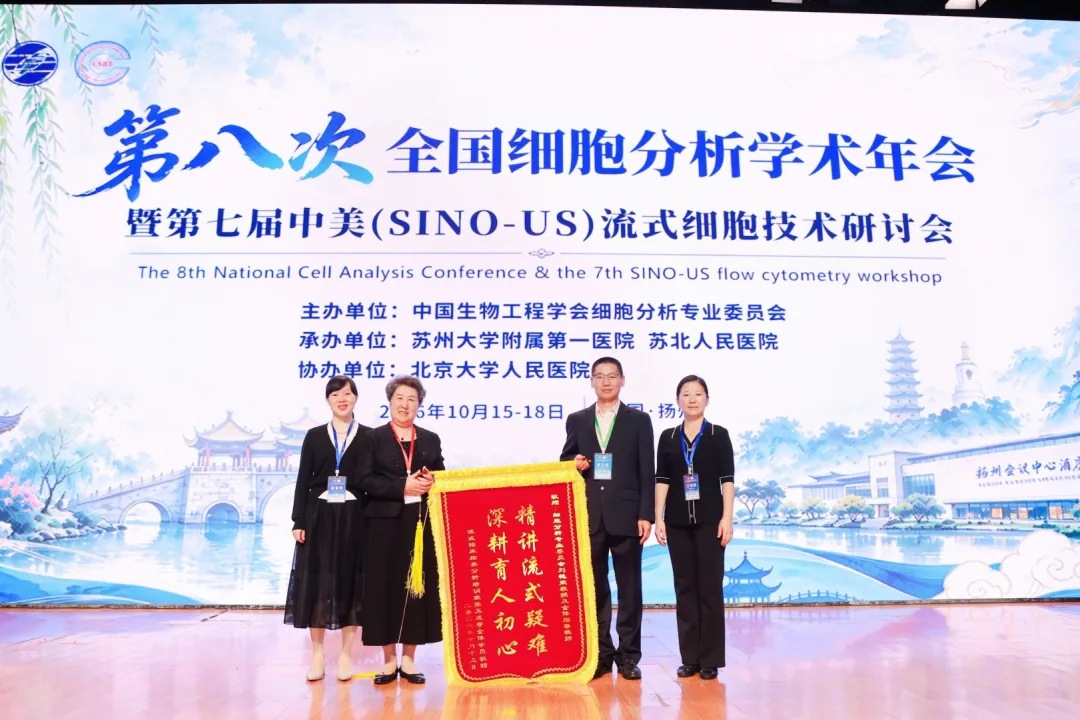
The 8th National Cell Analysis Conference and the 7th SINO-US Flow Cytometry Workshop were held from 15 to 18 October 2026, bringing together more than 400 specialists from universities, research institutes, clinical laboratories and industry. Across four days the programme worked through spectral cytometry, imaging flow cytometry, high-dimensional data analysis, clinical immunophenotyping and cytometry standardisation, combining plenary sessions with hands-on training.
The scale is a fair reflection of how central cytometry has become: minimal residual disease assessment, leukaemia and lymphoma immunophenotyping and cellular therapy monitoring all rest on it, and all of them depend on results being reproducible between laboratories and between instruments.
Six Parallel Workshops Covering the Whole Technical Chain
The spectral cytometry workshop opened the meeting on the afternoon of 15 October. Experts from the Shenzhen Medical Academy of Research and Translation, the University of Otago in New Zealand, Tsinghua University and Peking University worked through the principles of spectral cytometry, panel design and quality control, using 20- to 50-colour experiments to explain spectral unmixing, the choice of single-stain controls, autofluorescence extraction and standardisation in practice. Quality-control certification examinations and a clinical result interpretation skills course were held the same evening.
16 October was given over to six parallel training modules spanning the full technical chain:
The six workshops
- Extracellular vesicles and small particles: flow-based identification of EVs, basic and clinical applications and assay standardisation, followed by hands-on instrument sessions
- Imaging flow cytometry: principles of imaging flow, with rotational demonstration combining high-throughput analysis and cell imaging
- High-dimensional data analysis: tSNE dimensionality reduction and FlowSOM clustering in R and Cytobank, closing with an open roundtable on AI in cytometry, large language models and virtual cells
- Immunophenotyping: AML, B-ALL and T-ALL phenotyping and flow-based MRD assessment, taught case by case
- Instrument performance verification: verification requirements and pitfalls for flow cytometers, with live demonstrations
- Quality control and clinical reporting practice running across the four-day cycle
The immunophenotyping workshop is the module closest to routine clinical decision making. Faculty from Ruijin Hospital in Shanghai, the PLA General Hospital, Peking University People's Hospital, Jiangsu Provincial People's Hospital and the GOBROAD Flow Cytometry Institute taught systematic immunophenotyping of acute leukaemia and flow-based MRD detection, using case material to work through the analytical points that most often cause difficulty.
Opening Ceremony and Invited Reports
The opening ceremony took place on the morning of 17 October, with certificates presented to workshop participants and trainee representatives sharing what they had taken from the training.
The invited reports that followed drew together domestic and international work. Prof. Wei Haiming of the University of Science and Technology of China reviewed the basic science and clinical application of NK cells. Prof. Wei Xunbin of the Peking University Institute of Advanced Clinical Medicine presented a needle-free in vivo optical flow cytometer for detecting circulating tumour cells and extracellular vesicles. Prof. Hu Shimin of MD Anderson Cancer Center spoke under the title "More Than the Sum of Its Parts" on the value of multidisciplinary teamwork in haematologic tumour diagnosis. Kathryn Hally of the University of Otago and Wang Xuehai of the University of British Columbia reported on longitudinal immune biomarker studies and on a machine-learning system for real-time diagnosis of lymphoproliferative disorders.
Clinical and Research Tracks, and Standardisation as the Constant
The afternoon of 17 October split into clinical and research tracks. The clinical track covered immunophenotyping of uncommon leukaemias and in vivo flow monitoring, with speakers from the Sun Yat-sen University Cancer Center, West China Hospital and Peking University People's Hospital. The research track addressed spectral panel development and the future of high-parameter cytometers.
In the cytometry platform forum on standardisation and best practice, speakers addressed training curricula for standardised operation, reproducibility in longitudinal studies, standardised data pre-processing and methods for achieving comparable quantification across instruments. The same theme ran through the new-investigator forum that evening, where young researchers from Tsinghua University, Huazhong University of Science and Technology and Xuanwu Hospital presented work including mass cytometry reagent development, SpectraFM — a spectral cytometry pre-trained foundation model for leukaemia MRD detection — deep-learning-enabled imaging flow diagnosis, and a new high-throughput full-spectrum imaging cytometer.
The research track continued on 18 October with reports on single-cell metabolomic mass cytometry and on nanoparticle-based single-particle analysis of extracellular vesicles. A deliberately practical session, billed as a cytometry troubleshooting guide, used six 15-minute talks to work through recurrent problems in multicolour panel building, spectral panel design, instrument maintenance, 96-well sorting and sample preparation.
Running alongside was the clinical MDT case competition. Chaired by Liu Yanrong and Zhu Mingqing, with a mentoring panel including Gao Zifen, Zhai Yaping, Zhu Huanling and Weng Xiangqin, eight teams from hospitals across the country worked through difficult haematologic tumour cases in a multidisciplinary diagnostic format — a demonstration of how much of the diagnostic value of cytometry only emerges when it is read together with clinical and morphological information.
The GOBROAD Contribution: Phenotyping and MRD Teaching
For GOBROAD the meeting was primarily a teaching and standards contribution. Liu Yanrong, discipline lead of the GOBROAD Flow Cytometry Institute, taught in the immunophenotyping workshop on acute leukaemia phenotyping and flow-based MRD methodology, and co-chaired the clinical MDT case competition.
Both roles sit close to the institute's clinical focus. Immunophenotyping and MRD assessment determine how a leukaemia is classified, how a remission is defined and whether a treatment should be changed, and the MDT format is where discordant results between morphology, genetics and flow are actually resolved. Clear reporting standards and consistent interpretation are what make those discussions reliable — which is why standardisation, rather than any single instrument, was the thread running through all four days.
A Continuing SINO-US Bridge
As a standing platform for Sino-US exchange in cytometry, the workshop again brought specialists from MD Anderson Cancer Center, the University of Otago and the University of British Columbia together with Chinese colleagues. The parallel skills training and certification examinations held during the meeting also add to the workforce base for credentialing and standardisation in the field.
The consensus among participants was that the programme was both current and practical, that the training system was coherent, and that clinical and research content interacted rather than sitting side by side. For a discipline in which the result is only as good as the standard behind it, that combination is the point.
Learn More or Contact Us
If you would like to know more about the diagnostic pathways, treatment options or clinical studies described in this article, our international patient team can help you understand what is available at GOBROAD hospitals. Your personal information is protected in accordance with applicable regulations.